Brand Image
0%
Empowering Investigative Minds

IICSF

CUET PG

Free Resources

CUET PG

Forensic Science

INTRODUCTION TO FORENSIC SCIENCE

Definition, History, Development and Scope of Forensic Science in India. Basic Principles of
Forensic Science and its Significance, Organization and Functioning of State and Central
Forensic Science Laboratories, Ethics in Forensic Science.

PHYSICAL EVIDENCES

Definition, Types, Class and Individual Characteristics, Different Searching Methods for Locating
Physical Evidences at Scene of Crime, Chain of Custody.

FUNDAMENTAL OF POLICE

Historical Development of Police System in India. Police in Indian Constitution. Objective of
Police, General organization of Police at State & Range Level. Police Organization under
Central Government: General Information, Structure and Function of
A. [1] BSF (2] Assam Rifles [3] CRPF [4] CISF [5] ITBP [6] NSG
[1] BPR & D [2) CBI [3] lB [4] RAW [5] NCRB [6) NICFS [7] NPA [8] UT Police Force.

POLICE SCIENCE

Definition & Scope. Who is an Investigator, Investigator & his Qualities, General Guidelines for
Investigator, Interview of Witness and Interrogation ofsuspect.

SCENE OF CRIME

Meaning, Types , Protection of Scene of Crime, Crime Scene Documentation- Note Taking,
Videography, Photography and, Sketching Methods, Importance of Photography, General
Guidelines, Admissibility in Court, Various formssuch as Videography.

CRIME SCENE MANAGEMENT AND RECONSTRUCTION

Elements of Crime Scene Management: – Information Management, Technology Management,
Man-Power Management & Logistic Management. Introduction to Crime Scene Reconstruction,
Nature of Reconstruction, Basic Principles for Physical Evidence and Reconstruction
(Recognition, Identification, Individualization And Reconstruction), Stages in Reconstruction,
Types of Reconstruction, Pattern Evidence in Reconstruction (Bloodstain Pattern Analysis for
Reconstruction, Glass Fracture Patterns, Fire Burn Patterns, Tire and Skid Mark Patterns),
Writing A Reconstruction Report. IPC (1860), Cr. P.C (1973) and IEA (1872)

INDIAN PENAL CODE (1860)
Pertaining to Offences against Persons — Sections l20A, 299, 300, 302,304A, 304B, 307,309,
319, 320, 324, 326, 351, 354, 359, 362. Sections 375 & 377 and their Amendments.
Pertaining to Offences against Property Sections — 378, 383, 390, 391, 405,415, 420,441,
463, 4- 7, 498A, 499, 503, 511. Cr.P.C. (1973) Sections- 26, 27, 29, 31, 144, 154-158, 176, 291,
292, 293. IEA (1872) – Evidence and Rules of Relevancy in Brief, Expert Witness, Cross
Examination and Re-Examination of Witnesses. Sections – 32, 45, 46, 135, 136, 137, 138

FINGER PRINTS, DOCUMENTS AND OTHER IMPRESSIONS

Fingerprints: History, Types of Fingerprints, Type of Finger Print Patterns, Different
Classifications, Systems Location and Preservation of Fingerprints, Development of Latent
Prints by Physical and Chemical Methods, Matching of Fingerprints.
Documents: Definition of Questioned Documents, Types of Documents, Types of Writing
Instruments their Characteristics and Examination, Paper and its Examination, Basic Tools
needed for Forensic Document Examination- Ultraviolet, Visible, Infrared, and Fluorescence
Spectroscopy, Photomicrography, Microphotography, Visible Spectral Comparator, Electrostatic
Detection Apparatus.
Hand Writing: Hand Writing and its Characteristics, Factors Affecting Hand Writing, Samples
for Comparison, Comparison of Hand Writings, Disguised and Indented Writings and their
Detection, Typed and Computer Generated Documents, their Comparison, Alteration in
Documents and their Detection, Foot & Shoe Prints, Methods of their Preservation and
Examination, Tyre Marks and Track Marks and their Examination.

FORENSIC BIOLOGY AND SEROLOGY

Brief Description and Function of Human Digestive System, Respiratory System, Circulatory
System, Nervous System, Reproductive System.
Structure, Composition and Examination of biological fluids like – Blood and Bloodstains,
Seminal stains, Saliva, Urine, Pus, Feces etc.
Hair and Fiber: Hair Anatomy, Collection, Examination of Hairs from Animal and Human
Origin. Types of Fiber and their Properties, Examination etc.
Forensic Botany: Introduction, Nature & Scope, Woods & their Identification and Matching,
Diatoms and their Forensic Significance in Drowning Cases, Study and Identification of Pollen
Grains.
D N A: Structure of DNA, Polymorphism in DNA, General idea about RFLP and PCR Methods of
Biological Fluid Analysis, Merits and Demerits of RFLP and PCR, Advanced Methods for
Forensic DNA Examination etc.

CHEMICAL SEPARATION AND INSTRUMENTAL TECHNIQUES

General Understanding Of: Distillations, Sublimation, Crystallization, Solvent Extraction.
Chromatographic Techniques: Definition, Different Classification like- According to Mode,
Principle, Stationary Phase, etc., brief idea about Column Chromatography, Paper
Chromatography, Thin Layer Chromatography, Gas Liquid Chromatography, Liquid
Chromatography, Hyphenated Chromatographic techniques as LC-MS, GG-MS etc.
Electromagnetic Spectrum & Spectroscopic Methods — Principle, Apparatus, Procedure &
Importance: Emission Spectroscopy, Atomic Absorption Spectroscopy, UV Spectroscopy,
Electron Spectroscopy, Raman Spectroscopy, IR & FTIR Spectroscopy.
General Idea About: Neutron Activation Analysis, Mass Spectrometry
Electrophoresis- Principle, Types, Equipment and Processing, Immune electrophoresis,
Analysis of Proteins by electrophoresis and their detection.

FORENSIC MEDICINE:

Meaning And Scope, Identification of a Person: Through all Factors in Fixing Identity, PostMortem Examination (Autopsy) (Types of Autopsy, Objectives, and Procedures), Meaning & Modes of Death, and their Characteristics, Signs of Death and Post-Mortem Changes. Wounds
and their Characteristics, Injuries due to Heat, Lighting, Electricity and Radiation, Firearm
Injuries, Differentiation between Ante-Mortem and Post-Mortem Wounds.

FORENSIC TOXICOLOGY AND DRUG ANALYSIS

Poison and Types of Poisoning, Action of Poison, Factors Modifying the Action of Poison,
Extraction, Isolation and Clean-Up Procedures- For Non-Volatile Organic Poison, Volatile
Poisons, Toxic Cations or Metallic Poisons, Toxic Anions From Viscera, Drugs, Botanical
Evidence, Biological Evidence etc.
General idea and Examination of Opium, Semi — Synthetic Opiates, Cannabis products Such as
Bhang, Ganja And Charas, LSD And Amphetamine, Important Benzodiazepines,
Phenothiazines, Barbiturates Etc. Animal Poisons Like Snake, Cantharides, Bees, Wasp etc.

GENERAL CHEMISTRY:

Photochemistry: Interaction of Radiation with Matter, Difference between Thermal and
Photochemical Processes, Laws of Photochemistry, Grothus-Drapper Law, Stark-Einstein Law.
Jabolonski Diagram, Description of Fluorescence, Phosphoresence, Non-radiative Processes,
Quantum Yield, Photosensitized Reactions, Energy Transfer Processes etc.
Organic Chemistry- Structure and Bonding: Hybridization, Bond Length and Bond Angles,
Bond Energy, Localized and Delocalized Chemical Bond. Structure and Characteristics of
Alkane, Alkene, and Cycloalkane, Alcohol, Phenol, Ethers, Aldehyde, Ketone, Carboxylic Acid etc.
Inorganic Chemistry- Trends in Periodic Table and Applications in Predicting and Explaining
the Physical and Chemical Behaviors. Definitions of Acid and Base, Classification of Acids and
Bases, Essential and Trace Elements in Biological Process, Metallo Porphyrins with Special
Reference to Haemoglobin, Types of Magnetic Behaviors, Method of Determining Magnetic
Susceptibility, Spin only Formula, L-S Coupling.

BASIC PHYSICS

Physical Properties: Temperature, Weight and Mass, Density, Refractive Index, Diffraction,
Polarization. Laws of Motion- Motion in a Uniform Field, Centripetal Acceleration, Motion under a
Central Force. Basic Optics: Light as an Electromagnetic wave, Interference of Light, Principle of
Superposition, Two-Slit Interference, Michelson Interferometer and its Application.
Microscopy: Numerical Aperture and Resolving Power of Microscopic Systems, How the
Microscope Forms Images; Simple, Compound, Stereoscopic, Polarizing, Comparison,
Fluorescence and Electron Microscopes.

Locked

Not enrolled yet? Start your journey today. Choose a program to unlock all course materials and begin learning right away.

GENERAL FORENSICS

Unit 1

5 Videos
Locked

Not enrolled yet? Start your journey today. Choose a program to unlock all course materials and begin learning right away.

Locked

Not enrolled yet? Start your journey today. Choose a program to unlock all course materials and begin learning right away.

Locked

Not enrolled yet? Start your journey today. Choose a program to unlock all course materials and begin learning right away.

Locked

Not enrolled yet? Start your journey today. Choose a program to unlock all course materials and begin learning right away.

Locked

Not enrolled yet? Start your journey today. Choose a program to unlock all course materials and begin learning right away.

Locked

Not enrolled yet? Start your journey today. Choose a program to unlock all course materials and begin learning right away.

Locked

Not enrolled yet? Start your journey today. Choose a program to unlock all course materials and begin learning right away.

Locked

Not enrolled yet? Start your journey today. Choose a program to unlock all course materials and begin learning right away.

Locked

Not enrolled yet? Start your journey today. Choose a program to unlock all course materials and begin learning right away.

GENERAL FORENSICS
Definition

Forensic Science is the application and implementation of scientific methods and techniques for the purpose of justice. It involves analyzing evidence, identify suspects, understand the circumstances of a crime, and establish connections between crime scenes, individuals, and criminal activities.


History & Development
  • 700s : Chinese used fingerprints to establish identity of documents and clay sculpture, but without any formal classification system
  • 1248 : A Chinese book, Hsi Duan Yu (the washing away of wrongs), contains a description of how to distinguish drowning from strangulation. This was the first recorded application of medical knowledge to the solution of crime.
  • 1609 : The first treatise on systematic document examination was published by François Demelle of France
  • 1686 : Marcello Malpighi, a professor of anatomy at the University of Bologna, noted fingerprint characteristics. However, he made no mention of their value as a tool for individual identification
  • 1784 : In Lancaster, England, John Toms was convicted of murder on the basis of the torn edge of wad of newspaper in a pistol matching a remaining piece in his pocket. This was one of the first documented uses of physical matching.
  • 1800s : Thomas Bewick, an English naturalist, used engravings of his own fingerprints to identify books he published.
  • 1810 : Eugène François Vidocq, in return for a suspension of arrest and a jail sentence, made a deal with the police to establish the first detective force, the Sûreté of Paris.
  • 1810 : The first recorded use of question document analysis occurred in Germany. A chemical test for a particular ink dye was applied to a document known as the Konigin Hanschritt.
  • 1813 : Mathieu Orfila, a Spaniard who became professor of medicinal/forensic chemistry at University of Paris, published Traite des Poisons Tires des Regnes Mineral, Vegetal et Animal, ou Toxicologie General. Orfila is considered the father of modern toxicology. He also made significant contributions to the development of tests for the presence of blood in a forensic context and is credited as the first to attempt the use of a microscope in the assessment of blood and semen stains.
  • 1823 : John Evangelist Purkinje, a professor of anatomy at the University of Breslau, Czechoslovakia, published the first paper on the nature of fingerprints and suggested a classification system based on nine major types. However, he failed to recognize their individualizing potential.
  • 1828 : William Nichol invented the polarizing light microscope.
  • 1830s : Adolphe Quetelet, a Belgian statistician, provided the foundation for Bertillon’s work by stating his belief that no two human bodies were exactly alike
  • 1831 : Leuchs first noted amylase activity in human saliva.
  • 1835 : Henry Goddard, one of Scotland Yard’s original Bow Street Runners, first used bullet comparison to catch a murderer. His comparison was based on a visible flaw in the bullet which was traced back to a mold.
  • 1836 : James Marsh, an Scottish chemist, was the first to use toxicology (arsenic detection) in a jury trial.
  • 1839 : H. Bayard published the first reliable procedures for the microscopic detection of sperm. He also noted the different microscopic characteristics of various different substrate fabrics.
  • 1851 : Ludwig Teichmann, in Krakow, Poland, developed the first microscopic crystal test for hemoglobin using hemin crystals.
  • 1854 : An English physician, Maddox, developed dry plate photography, eclipsing M. Daguerre’s wet plate on tin method. This made practical the photographing of inmates for prison records.
  • 1856 : Sir William Herschel, a British officer working for the Indian Civil service, began to use thumbprints on documents both as a substitute for written signatures for illiterates and to verify document signatures.
  • 1862 : The Dutch scientist J. (Izaak) Van Deen developed a presumptive test for blood using guaiac, a West Indian shrub.
  • 1863 : The German scientist Schönbein first discovered the ability of hemoglobin to oxidize hydrogen peroxide making it foam. This resulted in first presumptive test for blood.
  • 1864 : Odelbrecht first advocated the use of photography for the identification of criminals and the documentation of evidence and crime scenes.
  • 1877 : Thomas Taylor, microscopist to U.S. Department of Agriculture suggested that markings of the palms of the hands and the tips of the fingers could be used for identification in criminal cases. Although reported in the American Journal of Microscopy and Popular Science and Scientific American, the idea was apparently never pursued from this source.
  • 1879 : Rudolph Virchow, a German pathologist, was one of the first to both study hair and recognize its limitations.
  • 1880 : Henry Faulds, a Scottish physician working in Tokyo, published a paper in the journal Nature suggesting that fingerprints at the scene of a crime could identify the offender. In one of the first recorded uses of fingerprints to solve a crime, Faulds used fingerprints to eliminate an innocent suspect and indicate a perpetrator in a Tokyo burglary.
  • 1882 : Gilbert Thompson, a railroad builder with the U.S Geological Survey in New Mexico, put his own thumbprint on wage chits to safeguard himself from forgeries.
  • 1883 : Alphonse Bertillon, a French police employee, identified the first recidivist based on his invention of anthropometry.
  • 1887 : Arthur Conan Doyle published the first Sherlock Holmes story in Beeton’s Christmas Annual of London.
  • 1889 : Alexandre Lacassagne, professor of forensic medicine at the University of Lyons, France, was the first to try to individualize bullets to a gun barrel. His comparisons at the time were based simply on the number of lands and grooves.
  • 1891 : Hans Gross, examining magistrate and professor of criminal law at the University of Graz, Austria, published Criminal Investigation, the first comprehensive description of uses of physical evidence in solving crime. Gross is also sometimes credited with coining the word criminalistics.
  • 1892 : (Sir) Francis Galton published Fingerprints, the first comprehensive book on the nature of fingerprints and their use in solving crime.
  • 1892 : Juan Vucetich, an Argentinean police researcher, developed the fingerprint classification system that would come to be used in Latin America. After Vucetich implicated a mother in the murder of her own children using her bloody fingerprints, Argentina was the first country to replace anthropometry with fingerprints.
  • 1894 : Alfred Dreyfus of France was convicted of treason based on a mistaken handwriting identification by Bertillon.
  • 1896 : Sir Edward Richard Henry developed the print classification system that would come to be used in Europe and North America. He published Classification and Uses of Fingerprints.
  • 1898 : Paul Jeserich, a forensic chemist working in Berlin, Germany, took photomicrographs of two bullets to compare, and subsequently individualize, the minutiae.
  • 1900 : Karl Landsteiner first discovered human blood groups and was awarded the Nobel prize for his work in 1930. Max Richter adapted the technique to type stains. This is one of the first instances of performing validation experiments specifically to adapt a method for forensic science. Landsteiner’s continued work on the detection of blood, its species, and its type formed the basis of practically all subsequent work.
  • 1901 : Paul Uhlenhuth, a German immunologist, developed the precipitin test for species. He was also one of the first to institute standards, controls, and QA/QC procedures. Wassermann (famous for developing a test for syphilis) and Schütze independently discovered and published the precipitin test, but never received due credit.
  • 1901 : Sir Edward Richard Henry was appointed head of Scotland Yard and forced the adoption of fingerprint identification to replace anthropometry.
  • 1901 : Henry P. DeForrest pioneered the first systematic use of fingerprints in the United States by the New York Civil Service Commission.
  • 1902 : Professor R.A. Reiss, professor at the University of Lausanne, Switzerland, and a pupil of Bertillon, set up one of the first academic curricula in forensic science. His forensic photography department grew into Lausanne Institute of Police Science.
  • 1903 : The New York State Prison system began the first systematic use of fingerprints in United States for criminal identification.
  • 1904 : Oskar and Rudolf Adler developed a presumptive test for blood based on benzidine, a new chemical developed by Merck.
  • 1904 : Locard published L’enquête criminelle et les méthodes scientifique, in which appears a passage that may have given rise to the forensic precept that “Every contact leaves a trace.”
  • 1906 : American President Theodore Roosevelt established Federal Bureau of Investigation (FBI).
  • 1910 : Victor Balthazard, professor of forensic medicine at the Sorbonne, with Marcelle Lambert, published the first comprehensive hair study, Le poil de l’homme et des animaux. In one of the first cases involving hairs, Rosella Rousseau was convinced to confess to murder of Germaine Bichon. Balthazard also used photographic enlargements of bullets and cartridge cases to determining weapon type and was among the first to attempt to individualize a bullet to a weapon.
  • 1910 : Edmund Locard, successor to Lacassagne as professor of forensic medicine at the University of Lyons, France, established the first police crime laboratory.
  • 1910 : Albert S. Osborne, an American and arguably the most influential document examiner, published Questioned Documents.
  • 1912 : Masao Takayama developed another microscopic crystal test for hemoglobin using hemochromogen crystals.
  • 1913 : Victor Balthazard, professor of forensic medicine at the Sorbonne, published the first article on individualizing bullet markings.
  • 1915 : Leone Lattes, professor at the Institute of Forensic Medicine in Turin Italy, developed the first antibody test for ABO blood groups. He first used the test in casework to resolve a marital dispute. He published L’Individualità del sangue nella biologia, nella clinica, nella medicina, legale, the first book dealing not only with clinical issues, but heritability, paternity, and typing of dried stains.
  • 1915 : International Association for Criminal Identification, (to become The International Association of Identification (IAI), was organized in Oakland, California.
  • 1916 : Albert Schneider of Berkeley, California first used a vacuum apparatus to collect trace evidence.
  • 1918 : Edmond Locard first suggested 12 matching points as a positive fingerprint identification.
  • 1920 : Charles E. Waite was the first to catalog manufacturing data about weapons.
  • 1920s : Georg Popp pioneered the use of botanical identification in forensic work.
  • 1920s : Luke May, one of the first American criminalists, pioneered striation analysis in tool mark comparison, including an attempt at statistical validation. In 1930 he published The identification of knives, tools and instruments, a positive science, in The American Journal of Police Science.
  • 1920s : Calvin Goddard, with Charles Waite, Phillip O. Gravelle, and John H Fisher, perfected the comparison microscope for use in bullet comparison.
  • 1921 : John Larson and Leonard Keeler designed the portable polygraph.
  • 1923 : Vittorio Siracusa, working at the Institute of Legal Medicine of the R. University of Messina, Italy, developed the absorption-elution test for ABO blood typing of stains. Along with his mentor, Lattes also performed significant work on the absorption-inhibition technique.
  • 1923 : In Frye v. United States, polygraph test results were ruled inadmissible. The federal ruling introduced the concept of general acceptance and stated that polygraph testing did not meet that criterion.
  • 1924 : August Vollmer, as chief of police in Los Angeles, California, implemented the first U.S. police crime laboratory.
  • 1925 : Saburo Sirai, a Japanese scientist, is credited with the first recognition of secretion of group-specific antigens into body fluids other than blood.
  • 1926 : The case of Sacco and Vanzetti, which took place in Bridgewater, Massachusetts, was responsible for popularizing the use of the comparison microscope for bullet comparison. Calvin Goddard’s conclusions were upheld when the evidence was reexamined in 1961.
  • 1927 : Landsteiner and Levine first detected the M, N, and P blood factors leading to development of the MNSs and P typing systems.
  • 1928 : Meüller was the first medico-legal investigator to suggest the identification of salivary amylase as a presumptive test for salivary stains.
  • 1929 : K. I. Yosida, a Japanese scientist, conducted the first comprehensive investigation establishing the existence of serological isoantibodies in body fluids other than blood.
  • 1929 : Calvin Goddard’s work on the St. Valentine’s day massacre led to the founding of the Scientific Crime Detection Laboratory on the campus of Northwestern University, Evanston, Illinois.
  • 1930 : American Journal of Police Science was founded and published by staff of Goddard’s Scientific Crime Detection Laboratory in Chicago. In 1932, it was absorbed by Journal of Criminal Law and Criminology, becoming the Journal of Criminal Law, Criminology and police science.
  • 1931 : Franz Josef Holzer, an Austrian scientist, working at the Institute for Forensic Medicine of the University of Innsbruck, developed the absorption-inhibition ABO typing technique that became the basis of that commonly used in forensic laboratories. It was based on the prior work of Siracusa and Lattes.
  • 1932 : The Federal Bureau of Investigation (FBI) crime laboratory was created.
  • 1935 : Frits Zernike, a Dutch physicist, invented the first interference contrast microscope, a phase contrast microscope, an achievement for which he won the Nobel prize in 1953.
  • 1937 : Holzer published the first paper addressing the usefulness of secretor status for forensic applications.
  • 1937 : Walter Specht, at the University Institute for Legal Medicine and Scientific Criminalistics in Jena, Germany, developed the chemiluminescent reagent luminol as a presumptive test for blood.
  • 1937 : Paul Kirk assumed leadership of the criminology program at the University of California at Berkeley. In 1945, he formalized a major in technical criminology.
  • 1938 : M. Polonovski and M. Jayle first identified haptoglobin.
  • 1940 : Landsteiner and A.S. Wiener first described Rh blood groups.
  • 1940 : Vincent Hnizda, a chemist with the Ethyl Corporation, was probably the first to analyze ignitable fluid. He used a vacuum distillation apparatus.
  • 1941 : Murray Hill of Bell Labs initiated the study voiceprint identification. The technique was refined by L.G. Kersta.
  • 1945 : Frank Lundquist, working at the Legal Medicine Unit at the University of Copenhagen, developed the acid phosphatase test for semen.
  • 1946 : Mourant first described the Lewis blood group system.
  • 1946 : R.R. Race first described the Kell blood group system
  • 1950 : M. Cutbush, and colleagues first described the Duffy blood group system.
  • 1950 : August Vollmer, chief of police of Berkeley, California, established the school of criminology at the University of California at Berkeley. Paul Kirk presided over the major of criminalistics within the school.
  • 1950 : Max Frei-Sulzer, founder of the first Swiss criminalistics laboratory, developed the tape lift method of collecting trace evidence.
  • 1950 : The American Academy of Forensic Science (AAFS) was formed in Chicago, Illinois. The group also began publication of the Journal of Forensic Science (JFS).
  • 1951 : F. H. Allen and colleagues first described the Kidd blood grouping system.
  • 1953 : Kirk published Crime Investigation, one of the first comprehensive criminalistics and crime investigation texts that encompassed theory in addition to practice.
  • 1954 : R. F. Borkenstein, captain of the Indiana State Police, invented the Breathalyzer for field sobriety testing.
  • 1958 : A. S. Weiner and colleagues introduced the use of H-lectin to determine positively O blood type.
  • 1959 : Hirshfeld first identified the polymorphic nature of group specific component (Gc).
  • 1960 : Lucas, in Canada, described the application of gas chromatography (GC) to the identification of petroleum products in the forensic laboratory and discussed potential limitations in the brand identity of gasoline.
  • 1960s : Maurice Muller, a Swiss scientist, adapted the Ouchterlony antibody-antigen diffusion test for precipiten testing to determine species.
  • 1963 : D.A. Hopkinson and colleagues first identified the polymorphic nature of erythrocyte acid phosphatase (EAP).
  • 1964 : N. Spencer and colleagues first identified the polymorphic nature of red cell phosphoglucomutase (PGM).
  • 1966 : R. A. Fildes and H. Harris first identified the polymorphic nature of red cell adenylate cyclase (AK).
  • 1966 : Brian J. Culliford and Brian Wraxall developed the immunoelectrophoretic technique for haptoglobin typing in bloodstains.
  • 1967 : Culliford, of the British Metropolitan Police Laboratory, initiated the development of gel-based methods to test for isoenzymes in dried bloodstains. He was also instrumental in the development and dissemination of methods for testing proteins and isoenzymes in both blood and other body fluids and secretions.
  • 1968 : Spencer and colleagues first identified the polymorphic nature of red cell adenosine deaminase (ADA).
  • 1971 : Culliford published The Examination and Typing of Bloodstains in the Crime Laboratory, generally accepted as responsible for disseminating reliable protocols for the typing of polymorphic protein and enzyme markers to the United States and worldwide.
  • 1973 : Hopkinson and colleagues first identified the polymorphic nature of esterase D (ESD).
  • 1974 : The detection of gunshot residue (GSR) using scanning electron microscopy with electron dispersive X-rays (SEMEDX) technology was developed by J. E. Wessel, P. F. Jones, Q. Y. Kwan, R. S. Nesbitt and E. J. Rattin at Aerospace Corporation.
  • 1975 : J. Kompf and colleagues, working in Germany, first identified the polymorphic nature of red cell glyoxalase (GLO).
  • 1975 : The Federal Rules of Evidence, originally promulgated by the U.S. Supreme Court, were enacted as a congressional statute. They are based on the relevancy standard in which scientific evidence that is deemed more prejudicial than probative may not be admitted.
  • 1976 : Zoro and Hadley in the United Kingdom first evaluated GC-MS for forensic purposes.
  • 1977 : Fuseo Matsumur, a trace evidence examiner at the Saga Prefectural Crime Laboratory of the National Police Agency of Japan, notices his own fingerprints developing on microscope slides while mounting hairs from a taxi driver murder case. He relates the information to co-worker Masato Soba, a latent print examiner. Soba would later that year be the first to develop latent prints intentionally by “Supergluefuming.
  • 1977 : The fourier transform infrared spectrophotometer (FTIR) is adapted for use in the forensic laboratory.
  • 1977 : The FBI introduced the beginnings of its Automated Fingerprint Identification System (AFIS) with the first computerized scans of fingerprints.
  • 1978 : Brian Wraxall and Mark Stolorow developed the “multisystem” method for testing the PGM, ESD, and GLO isoenzyme systems simultaneously. They also developed methods for typing blood serum proteins such as haptoglobin and Gc.
  • 1984 : Alec Jeffreys developed the first DNA profiling test. It involved detection of a multilocus RFLP pattern. He published his findings in Nature in 1985.
  • 1986 : In the first use of DNA to solve a crime, Jeffreys used DNA profiling to identify Colin Pitchfork as the murderer of two young girls in the English Midlands. Significantly, in the course of the investigation, DNA was first used to exonerate an innocent suspect.
  • 1983 : The polymerase chain reaction (PCR) was first conceived by Kary Mullis, while he was working at Cetus Corporation. The first paper on the technique was not published until 1985.
  • 1986 : The human genetics group at Cetus Corporation, led by Henry Erlich, developed the PCR technique for a number of clinical and forensic applications. This resulted in development of the first commercial PCR typing kit specifically for forensic use, HLA DQα (DQA1), about 2 years later.
  • 1986 : In People v. Pestinikas, Edward Blake first used PCR-based DNA testing (HLA DQα) , to confirm different autopsy samples to be from the same person. The evidence was accepted by a civil court. This was also the first use of any kind of DNA testing in the United States
  • 1987 : DNA profiling was introduced for the first time in a U.S. criminal court. Based on RFLP analysis performed by Lifecodes, Tommy Lee Andrews was convicted of a series of sexual assaults in Orlando, Florida.
  • 1987 : New York v. Castro was the first case in which the admissibility of DNA was seriously challenged. It set in motion a string of events that culminated in a call for certification, accreditation, standardization, and quality control guidelines for both DNA laboratories and the general forensic community.
  • 1988 : Lewellen, McCurdy, and Horton, and Asselin, Leslie, and McKinley both publish milestone papers introducing a novel procedure for the analysis of drugs in whole blood by homogeneous enzyme immunoassay (EMIT).
  • 1990 : K. Kasai and colleagues published the first paper suggesting the D1S80 locus (pMCT118) for forensic DNA analysis. D1S80 was subsequently developed by Cetus (subsequently Roche Molecular Systems) corporation as a commercially available forensic DNA typing system.
  • 1991 : Walsh Automation Inc., in Montreal, launched development of an automated imaging system called the Integrated Ballistics Identification System, or IBIS, for comparison of the marks left on fired bullets, cartridge cases, and shell casings. This system was subsequently developed for the U.S. market in collaboration with the Bureau of Alcohol, Tobacco, and Firearms (ATF).
  • 1992 : In response to concerns about the practice of forensic DNA analysis and interpretation of the results, the National Research Council Committee on Forensic DNA (NRC I) published DNA Technology in Forensic Science.
  • 1992 : Thomas Caskey, professor at Baylor University in Texas, and colleagues published the first paper suggesting the use of short tandem repeats for forensic DNA analysis. Promega corporation and Perkin-Elmer corporation in collaboration with Roche Molecular Systems independently developed commercial kits for forensic DNA STR typing.
  • 1992 : The FBI contracted with Mnemonic Systems to developed Drugfire, an automated imaging system to compare marks left on cartridge cases and shell casings. The ability to compare fired bullets was subsequently added.
  • 1993 : In Daubert et al. v. Merrell Dow, a U.S. federal court relaxed the Frye standard for admission of scientific evidence and conferred on the judge a “gatekeeping” role. The ruling cited Karl Popper’s views that scientific theories are falsifiable as a criterion for whether something is “scientific knowledge” and should be admissible.
  • 1994 : Roche Molecular Systems (formerly Cetus) released a set of five additional DNA markers (“polymarker”) to add to the HLA-DQA1 forensic DNA typing system.
  • 1996 : In response to continued concerns about the statistical interpretation of forensic DNA evidence, a second National Research Council Committee on Forensic DNA (NRC II) was convened and published The Evaluation of Forensic DNA Evidence.
  • 1996 : The FBI introduced computerized searches of the AFIS fingerprint database. Live scan and card scan devices allowed interdepartmental submissions.
  • 1996 : In Tennessee v. Ware, mitochondrial DNA typing was admitted for the first time in a U.S. court.
  • 1998 : An FBI DNA database, NIDIS, enabling interstate cooperation in linking crimes, was put into practice.
  • 1999 : The FBI upgraded its computerized fingerprint database and implemented the Integrated Automated Fingerprint Identification System (IAFIS), allowing paperless submission, storage, and search capabilities directly to the national database maintained at the FBI.
  • 1999 : A Memorandum of Understanding is signed between the FBI and ATF, allowing the use of the National Integrated Ballistics Network (NIBIN), to facilitate exchange of firearms data between Drugfire and IBIS.
History of Forensic Science in India
  • 1849 : First Chemical laboratory established in Madras. Similar labs were established in Calcutta in 1853, Agra in 1864 & Bombay in 1870.
  • 1879 : Anthropometric Bureau in Calcutta was established
  • 1897 : First Fingerprint bureau in the world was established in Calcutta. Richard Henry developed Ten finger Fingerprint Classification with the aid by Khan Bahadur Azizul Huq & Rai Bahadur Hem Chandra Sen
  • 1898 : Nagpur Department of Explosives established. Five Regional offices were established in : Kolkata, Bombay, Madras, Agra, Gwalior. Three Sub offices were established in Sivakasi, Domia & Asansol.
  • 1902 : Calcutta CID was established. Rai Bahadur pandit shambhu nath is considered as Father of Indian CID.
  • 1904 : GEQD Kolkata established Headed by C.R.Hardless
    • 1906 transferred to Shimla GEQD Headed by F Brewster under CID
      • 1949 S.N Sen 1st Indian Head 
  • 1910 : Kolkata Serology department was established. It was later renamed after Independence as Office of serologist & chemical examiner to the Government of India.
  • 1915 : Footprint Section under CID Kolkata was established.
  • 1917 : Note Forgery Section under CID Kolkata was established.
  • 1930 : A Ballistics laboratory along with an Arms expert in Kolkata was established.
  • 1952 : SFSL Kolkata was established.
  • 1905 : CFPB Shimla established on the recommendation of Royal Police Commission. But later in 1922 was abolished on the recommendation of Inchcape Committee
  • 1955 : CFPB Delhi was established under IB later was Transferred under CBI in 1973
  • 1956 : CDTS Kolkata was established
  • 1957 : CFSL Kolkata was established. In 1970 Neutron activation analysis under CFSL Kolkata was set up at BARC Trombay
  • 1960 : Indian Academy of forensic science established
  • 1972 : LNJN NICFS Delhi was established
  • 1983 : Post of Chief forensic scientist & Forensic science directorate created under BPR&D on the recommendation of V.K.Street, UK.
  • 1998 : DNA typing facility in CFSL Kolkata was started.
  • Merger of GEQD
    • GEQD Kolkata merged with CFSL Kolkata
    • GEQD Shimla merged with CFSL Chandigarh
    • GEQD Hyderabad merged with CFSL Hyderabad
  • Centre of Excellence
    • CFSL Kolkata: Biology
    • CFSL Hyderabad: Chemical
    • CFSL Chandigarh: Physical
  • “ Neutron activation brought under CFSL Hyderabad from BARC Trombay”

Committee for establishment of SFSL

  • Central forensic science advisory committee,1959 under MHA, N.Delhi later transformed into Standing Committee on Forensics Science, 1972 under BPR&D still exist
  • Central medico legal advisory committee,1955 under MHA, N.Delhi later Dissolved
  •  

Committee on Teaching of forensic science in University

  • Central advisory committee on forensics
    • Headed by K.F. Rustamji
    • Advised by UGC head DS Kothar & BPR&D head DP Kohli

Scope

The scope of forensic science is broad and encompasses various scientific disciplines and applications. Here are the primary areas:

  1. Crime Scene Investigation: Involves the identification, documentation, collection, and preservation of evidence at crime scenes, ensuring its integrity for analysis.

  2. Forensic Biology and DNA Analysis: Analyzes biological samples (e.g., blood, saliva, hair) for DNA profiling, crucial for identifying individuals and establishing connections between victims and suspects.

  3. Forensic Chemistry: Focuses on analyzing substances like drugs, poisons, explosives, and other chemicals found at crime scenes to understand their composition and relevance.

  4. Forensic Toxicology: Studies the effects of drugs, alcohol, poisons, and other chemicals in the body to help determine cause of death, impairment, or poisoning.

  5. Forensic Pathology: Examines bodies to determine the cause and manner of death, often involving autopsies and analysis of injuries, disease, or trauma.

  6. Forensic Anthropology: Analyzes human skeletal remains to establish identity, cause of death, and other information, particularly when the body is decomposed.

  7. Forensic Odontology: Uses dental records and bite mark analysis to help identify victims or connect suspects to a crime.

  8. Forensic Entomology: Studies insects and other organisms found on decomposing remains to estimate time of death and other forensic details.

  9. Forensic Ballistics: Examines firearms, bullets, gunshot residues, and related materials to determine how a shooting occurred and identify weapons.

  10. Forensic Document Examination: Analyzes handwriting, typesetting, ink, paper, and other document features to authenticate or detect forgery.

  11. Digital Forensics: Investigates digital devices and data (e.g., computers, smartphones, networks) to recover, analyze, and interpret electronic evidence.

  12. Forensic Psychology: Assesses the mental state of suspects, witnesses, and victims to determine competency, intent, or psychological motives.

  13. Forensic Accounting: Analyzes financial records to detect fraud, embezzlement, or financial misconduct.

  14. Forensic Engineering: Investigates accidents, structural failures, and product malfunctions to determine the cause and potential negligence.

  15. Wildlife Forensics: Applies forensic science techniques to crimes involving animals, such as poaching and illegal trade of endangered species.

  16. Cyber Forensics: Focuses on investigating cybercrimes, including hacking, cyberstalking, and other internet-based crimes.

  17. Environmental Forensics: Analyzes environmental contamination to identify sources of pollution and hold parties accountable for environmental crimes.

  18. Forensic Linguistics: Examines language patterns, word choice, and grammar in written or spoken communication to assess authorship or interpret meaning in legal contexts.

  19. Forensic Archeology: Combines archeological methods with forensic science to uncover and examine remains and artifacts from historic crime scenes or mass graves.

Ethics in Forensic Science

Key aspects of ethics in forensic science:

  1. Objectivity and Impartiality: Forensic scientists must remain unbiased, providing conclusions based solely on evidence, without personal beliefs or external pressures influencing their findings.

  2. Accuracy and Reliability: Forensic analysis should follow established protocols and methods to ensure results are accurate, reproducible, and scientifically valid.

  3. Confidentiality: Sensitive information from cases must be kept confidential to protect the rights and privacy of individuals involved, with data shared only with authorized personnel.

  4. Integrity of Evidence: Evidence must be collected, handled, and stored correctly to prevent contamination, loss, or tampering, maintaining a strict chain of custody.

  5. Honesty in Reporting: Reports should accurately reflect findings, including any limitations or uncertainties, without exaggerating results or making unsupported conclusions.

  6. Competence: Forensic scientists should work within their area of expertise, continuously updating their skills and knowledge to provide reliable analysis.

  7. Avoiding Conflicts of Interest: Scientists should disclose and avoid any conflicts that might compromise their objectivity, such as personal, financial, or professional interests.

  8. Testimony Integrity: When testifying, forensic experts should communicate findings truthfully, clearly, and without bias, ensuring they do not mislead the court.

  9. Respect for Human Rights: All forensic work should respect individuals’ rights, avoid unethical practices, and support justice without discrimination.

  10. Accountability: Forensic scientists should be accountable for their work, open to peer review, and willing to admit and correct errors to maintain public trust in the field.

Each ethical principle ensures that forensic science upholds justice, reliability, and public confidence in legal proceedings.


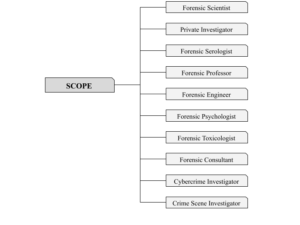
SCOPE

Scope of Forensic science is vast and will continue to expand in future. Scope of forensic science has been mentioned in figure below, but it is not restricted or limited to these scopes only.

BASIC PRINCIPLES AND ITS SIGNIFICANCE

Forensic science is based on several fundamental principles that guide the collection, analysis, and interpretation of evidence. These principles ensure the reliability and admissibility of forensic evidence in court.

  1. Principle of Exchange

Proposed by Dr. Edmond Locard, this principle states that “every contact leaves a trace.” When two objects come into contact, there is always an exchange of materials between them.

Significance: This principle forms the basis for crime scene investigation. It emphasizes the importance of collecting trace evidence (e.g., hair, fibers, fingerprints) to link suspects to crime scenes.

  1. Principle of Individuality

Every object, natural or man-made, has unique characteristics that distinguish it from others.

Significance: This principle is applied in fingerprint analysis, DNA profiling, and tool mark analysis to establish the uniqueness of evidence.

  1. Principle of Progressive Change

Crime scenes and evidence are dynamic and change over time due to environmental factors, human activity, or decomposition.

Significance: Investigators must document and collect evidence promptly to prevent contamination or loss.

  1. Principle of Comparison

Forensic evidence is analyzed by comparing it with known standards or samples.

Significance: This principle is used in ballistics, handwriting analysis, and DNA testing to establish matches between evidence and suspects.

  1. Principle of Analysis

Forensic evidence must be analyzed using scientific methods to draw objective conclusions.

Significance: Ensures that evidence is interpreted accurately and without bias.

  1. Principle of Probability

Forensic conclusions are often based on statistical probabilities rather than absolute certainty.

Significance: This principle is particularly relevant in DNA analysis, where results are expressed as likelihood ratios.

  1. Principle of Circumstantial Evidence

Definition: Indirect evidence that implies a fact but does not directly prove it.

Significance: Circumstantial evidence, when combined with other evidence, can build a strong case against a suspect.

ORGANIZATION AND FUNCTIONING OF SFSL & CFSL

Forensic Science Laboratories (FSLs) in India operate at Central and State levels to provide scientific support to the criminal justice system by examination of physical, chemical, biological, and digital evidence.

CENTRAL FORENSIC SCIENCE LABORATORY (CFSL)
A. Organization of CFSL
  • CFSLs function under the Ministry of Home Affairs (MHA), Government of India.

  • Major CFSLs are located at:

    • CFSL, CBI – New Delhi

    • CFSL – Hyderabad

    • CFSL – Kolkata

    • CFSL – Chandigarh

    • CFSL – Pune

    • CFSL – Bhopal

    • CFSL – Guwahati

  • Overall administrative control:

    • Director, CFSL

    • Assisted by Joint Directors / Deputy Directors

  • Divided into specialized forensic divisions.

B. Major Divisions of CFSL
  • Biology & Serology

  • DNA Fingerprinting

  • Chemistry & Toxicology

  • Ballistics

  • Questioned Documents

  • Physics

  • Cyber Forensics

  • Explosives

  • Psychology (Polygraph, Narco, BEAP – select CFSLs)

C. Functions of CFSL
  • Examination of cases of national importance

  • Handling cases investigated by:

    • CBI

    • NIA

    • Central agencies and Union Territories

  • Expert opinion to courts under Section 45, Indian Evidence Act

  • Research & development in forensic science

  • Training of forensic scientists, police, judiciary

  • Standardization of forensic procedures

  • Advisory role to State FSLs


STATE FORENSIC SCIENCE LABORATORY (SFSL)
A. Organization of SFSL
  • Established by State Governments

  • Functions under:

    • Home Department / Police Department of the State

  • Administrative hierarchy:

    • Director, SFSL

    • Joint / Deputy / Assistant Directors

    • Scientific Officers & Technical Staff

  • May have Regional FSLs (RFSLs) and District Mobile Units

DIFFERENCE BETWEEN CFSL & SFSL 
AspectCFSLSFSL
ControlCentral Government (MHA)State Government
JurisdictionNational / Inter-State / UTsWithin State
Agencies servedCBI, NIA, Central agenciesState police
InfrastructureHighly advancedVaries by state
RoleApex forensic bodyPrimary state forensic support

IMPORTANCE IN CRIMINAL JUSTICE SYSTEM
  • Ensures scientific, objective evidence

  • Reduces reliance on confessions

  • Enhances conviction rate

  • Prevents miscarriage of justice

  • Supports modern, technology-based investigations

Nature & Types

Physical Evidence: Any tangible items that may be found at the crime scene, on the victims, or on the culprit are referred to as physical evidence. 

Trace Evidence: The term “tracing evidence” refers to physical evidence that is present in minute but quantifiable numbers.

In a criminal investigation, the analysis of the evidence acquired at the scene is utilized to support or refute the case’s facts. 

Physical evidence can be either:
  • Primary Evidence: Directly proves a fact, like an eyewitness testimony or video footage showing an event.
  • Corroborative evidence: Correlating data, which frequently validates or supports a criminal hypothesis,
  • Circumstantial evidence:  Infers a conclusion indirectly about crime.
  • Conflicting evidence: Irreconcilable evidence that comes from different sources
  • Exculpatory evidence: Evidence tending to establish a criminal defendant’s innocence 
  • Incriminating evidence: Evidence tending to establish guilt
  • Inceptive evidence: It is used to show whether or not a crime has been committed.
  • Testimonial Evidence: Statements made by witnesses or experts under oath.
  • Hearsay Evidence: Statements made outside the court, generally not admissible unless exceptions apply.

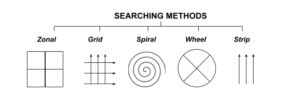
Search methods

There are several common search methods, each method is chosen based on the size, type, and nature of the search area and the specific goals of the investigation or study.

  • Grid Search: The search area is divided into a grid, and each section is thoroughly searched. Useful for small, confined areas.
  • Zone or Sector Search: The area is divided into zones or sectors, and each one is searched individually. This is ideal for complex scenes with various rooms or barriers.
  • Spiral Search: The searcher starts at a central point and moves outward in a circular or spiral pattern. This method is useful in large, open areas.
  • Line or Strip Search: Searchers line up and move in a straight line across the area. Each person covers a specific width to ensure no gaps. This is effective for large, flat areas.
  • Wheel Search: Similar to the zone search, but typically divides the area into sectors, each of which is searched thoroughly. Often used for large, specific search areas.
  • Random Search: There is no systematic pattern; the search is conducted randomly, often in cases where time is limited, and precision is less critical.

Collection, Preservation, Packing & Forwarding of Physical & Trace evidence for forensic analyses
1. Collection of Physical & Trace Evidence
  • Goal: Evidence is collected accurately, avoiding contamination or degradation.
  • Types of Evidence:
    • Physical Evidence: Larger, visible items like weapons, clothing, and bloodstains.
    • Trace Evidence: Microscopic or smaller materials, such as hair, fibers, glass fragments, and soil.
  • Steps:
    • Document Scene: Photographs, videos, and detailed notes are taken before any items are moved or collected.
    • Prioritize Evidence: Fragile or degradable evidence, such as biological samples, is collected first to prevent deterioration.
    • Use Appropriate Tools: Tweezers, gloves, and masks are used to avoid contamination; bare hands do not touch evidence.
    • Establish Chain of Custody: Every handler and transfer of evidence is recorded to maintain legal admissibility.
2. Preservation of Physical & Trace Evidence
  • Goal: Evidence degradation or alteration is prevented until analysis.
  • Methods:
    • Temperature Control: Biological samples are refrigerated or frozen to prevent bacterial growth.
    • Prevent Contamination: Different types of evidence are stored separately to avoid cross-contamination, such as keeping biological samples isolated.
    • Protection from Environment: Evidence is shielded from sunlight, humidity, and extreme temperatures to prevent degradation.
    • Minimize Handling: Direct handling is limited, and unnecessary movement or contact with evidence items is avoided.
  • Documentation:
    • Each item is labeled with a unique identifier, date, and collection details.
    • Any preservation techniques or changes in the evidence’s condition after collection are documented.
3. Packing of Physical & Trace Evidence
  • Goal: Evidence is packaged securely for lab transport, maintaining its integrity.
  • Packing Techniques:
    • Use Appropriate Packaging Materials:
      • Biological evidence is placed in paper bags or envelopes (plastic is avoided to prevent DNA degradation).
      • Trace evidence, like fibers and hair, is stored in small envelopes, glass vials, or druggist folds.
      • Sharp objects are placed in rigid, puncture-resistant containers to prevent injury and contamination.
    • Label Packaging: Each package is clearly labeled with evidence type, date, case number, and collector’s name.
    • Seal Containers: Tamper-evident tape and seals are used to prevent unauthorized access.
  • Special Considerations:
    • Evidence is packed separately to prevent cross-contamination, especially for biological samples.
    • Hazardous materials are double-bagged to ensure secure containment.
4. Forwarding Evidence for Forensic Analysis
  • Goal: Evidence is transported to the forensic lab, preserving the chain of custody and ensuring safe handling.
  • Procedures:
    • Chain of Custody Documentation: All necessary documentation, including transfer forms outlining the evidence’s history and handling, is completed.
    • Forwarding Letter: A formal note accompanies the items sent to the lab, outlining the purpose, contents, and authorities’ signatures.
    • Secure Transport: Lockable containers or tamper-evident bags are used, with handling limited to authorized personnel only.
    • Special Handling Instructions: Specific handling requirements (e.g., refrigeration, fragile material) are clearly indicated on packaging and transfer forms.

Chain of Custody

Chain of custody is the process of maintaining and documenting the handling, transfer, and storage of evidence from the moment it is collected until it is presented in court or analysis is completed. It ensures that evidence is accounted for and remains uncontaminated and tamper-free, preserving its integrity for legal and investigative purposes.

Purpose:
  • Legal Integrity: Establishes evidence as admissible in court by proving it has not been altered or tampered with.
  • Accountability: Ensures that every individual who handles the evidence can be identified, supporting transparency in evidence handling.
  • Authenticity: Confirms that evidence presented in court is the same as what was originally collected at the scene.
Key Components:
  • Documentation:
    • Each piece of evidence is accompanied by a chain of custody form that records the unique identifier, case details, date, time, and location of collection.
    • Any transfer, examination, or alteration to the evidence must be documented in real-time, noting the name of each handler and any changes observed.
  • Unique Identification:
    • Evidence items are tagged or labeled with unique identifiers, like barcodes or alphanumeric codes, that correspond to chain of custody records.
    • Tags include information such as the case number, collection date, location, and evidence type.
  • Custody Transfers:
    • Each transfer or handoff of evidence from one individual to another is logged, with signatures or initials from both parties to verify accountability.
    • Only authorized personnel can access or handle evidence, reducing the risk of unauthorized interference.
  • Security Measures:
    • Evidence is stored in secure, controlled-access environments (e.g., locked evidence rooms or cabinets) when not being examined.
    • Security protocols include limited access, tamper-evident seals, and alarm systems to prevent unauthorized access.
Process:
  1. Collection:
    • Evidence is collected at the scene, documented thoroughly, and tagged with identifying information.
    • The chain of custody form is initiated, noting collection details and the identity of the collector.
  2. Transfer and Handling:
    • Evidence is transferred as needed for transport, analysis, or storage. Each transfer is logged, with both the sender and receiver recording the transaction.
    • Handling is minimized to reduce contamination or damage; appropriate tools (gloves, forceps) are used.
  3. Storage:
    • Evidence is stored securely, with conditions (e.g., temperature control) maintained according to evidence type.
    • Log entries are made for any access or movement within storage facilities.
  4. Analysis:
    • Evidence analyzed in labs is checked out and documented, noting the purpose and timeframe of the examination.
    • Any alteration in the condition of evidence during analysis is documented, and chain of custody records are updated.
  5. Court Presentation:
    • When evidence is presented in court, chain of custody documents are provided to establish its authenticity and reliability.
    • After court proceedings, evidence is either stored, returned, or appropriately disposed of, with documentation maintained.
Importance:
  • Ensures Reliability: A well-maintained chain of custody supports the credibility of evidence, increasing the reliability of forensic results.
  • Protects Against Legal Challenges: Gaps or inconsistencies in chain of custody documentation can lead to evidence exclusion in court.
  • Maintains Public Trust: Proper evidence handling builds public trust in investigative and legal institutions, showing transparency and accountability.
Challenges:
  • Human Error: Mistakes in labeling, documentation, or handling can create gaps or inaccuracies.
  • Storage Limitations: Inadequate facilities or security can compromise evidence integrity.
  • Complexity in High-Volume Cases: Managing large amounts of evidence over long periods can strain record-keeping and storage systems.


ORGANIZATION AND FUNCTIONING OF SFSL & CFSL

Forensic Science Laboratories (FSLs) in India operate at Central and State levels to provide scientific support to the criminal justice system by examination of physical, chemical, biological, and digital evidence.

CENTRAL FORENSIC SCIENCE LABORATORY (CFSL)
A. Organization of CFSL
  • CFSLs function under the Ministry of Home Affairs (MHA), Government of India.

  • Major CFSLs are located at:

    • CFSL, CBI – New Delhi

    • CFSL – Hyderabad

    • CFSL – Kolkata

    • CFSL – Chandigarh

    • CFSL – Pune

    • CFSL – Bhopal

    • CFSL – Guwahati

  • Overall administrative control:

    • Director, CFSL

    • Assisted by Joint Directors / Deputy Directors

  • Divided into specialized forensic divisions.

B. Major Divisions of CFSL
  • Biology & Serology

  • DNA Fingerprinting

  • Chemistry & Toxicology

  • Ballistics

  • Questioned Documents

  • Physics

  • Cyber Forensics

  • Explosives

  • Psychology (Polygraph, Narco, BEAP – select CFSLs)

C. Functions of CFSL
  • Examination of cases of national importance

  • Handling cases investigated by:

    • CBI

    • NIA

    • Central agencies and Union Territories

  • Expert opinion to courts under Section 45, Indian Evidence Act

  • Research & development in forensic science

  • Training of forensic scientists, police, judiciary

  • Standardization of forensic procedures

  • Advisory role to State FSLs


STATE FORENSIC SCIENCE LABORATORY (SFSL)
A. Organization of SFSL
  • Established by State Governments

  • Functions under:

    • Home Department / Police Department of the State

  • Administrative hierarchy:

    • Director, SFSL

    • Joint / Deputy / Assistant Directors

    • Scientific Officers & Technical Staff

  • May have Regional FSLs (RFSLs) and District Mobile Units

DIFFERENCE BETWEEN CFSL & SFSL 
AspectCFSLSFSL
ControlCentral Government (MHA)State Government
JurisdictionNational / Inter-State / UTsWithin State
Agencies servedCBI, NIA, Central agenciesState police
InfrastructureHighly advancedVaries by state
RoleApex forensic bodyPrimary state forensic support

IMPORTANCE IN CRIMINAL JUSTICE SYSTEM
  • Ensures scientific, objective evidence

  • Reduces reliance on confessions

  • Enhances conviction rate

  • Prevents miscarriage of justice

  • Supports modern, technology-based investigations
Locked

Not enrolled yet? Start your journey today. Choose a program to unlock all course materials and begin learning right away.

Locked

Not enrolled yet? Start your journey today. Choose a program to unlock all course materials and begin learning right away.

Locked

Not enrolled yet? Start your journey today. Choose a program to unlock all course materials and begin learning right away.

Locked

Not enrolled yet? Start your journey today. Choose a program to unlock all course materials and begin learning right away.

Locked

Not enrolled yet? Start your journey today. Choose a program to unlock all course materials and begin learning right away.

Locked

Not enrolled yet? Start your journey today. Choose a program to unlock all course materials and begin learning right away.

Locked

Not enrolled yet? Start your journey today. Choose a program to unlock all course materials and begin learning right away.

Locked

Not enrolled yet? Start your journey today. Choose a program to unlock all course materials and begin learning right away.

Locked

Not enrolled yet? Start your journey today. Choose a program to unlock all course materials and begin learning right away.

BOOKS RECOMMENDATION
Locked

Not enrolled yet? Start your journey today. Choose a program to unlock all course materials and begin learning right away.

Locked

Not enrolled yet? Start your journey today. Choose a program to unlock all course materials and begin learning right away.

Locked

Not enrolled yet? Start your journey today. Choose a program to unlock all course materials and begin learning right away.

Locked

Not enrolled yet? Start your journey today. Choose a program to unlock all course materials and begin learning right away.

Locked

Not enrolled yet? Start your journey today. Choose a program to unlock all course materials and begin learning right away.

Locked

Not enrolled yet? Start your journey today. Choose a program to unlock all course materials and begin learning right away.

Locked

Not enrolled yet? Start your journey today. Choose a program to unlock all course materials and begin learning right away.

Locked

Not enrolled yet? Start your journey today. Choose a program to unlock all course materials and begin learning right away.

Locked

Not enrolled yet? Start your journey today. Choose a program to unlock all course materials and begin learning right away.

0%

CUET PG 2025 PYQs

1 / 75

Category: CUET PG 2025

1) The Cobra battalion works under the operational command of which of the following Police organization:

2 / 75

Category: CUET PG 2025

2) Match the LIST-I with LIST-II: A. Og - I. Transitional metals, B. Po - II. Non-metal, C. Os - III. Metaloid, D. Se - IV. Noble gas

3 / 75

Category: CUET PG 2025

3) A DNA expert in a forensic science laboratory confirms: A. Toxins in exhibit, B. Age of individual, C. Identity of an individual, D. Gender of an individual, E. Height of an individual

4 / 75

Category: CUET PG 2025

4) When a person leans up against an object present at the scene of crime and leaves behind the pattern of his or her clothing, is called as:

5 / 75

Category: CUET PG 2025

5) The genetic constitution of the combined paternal and maternal DNA responsible for producing the different ABO blood groups is referred as:

6 / 75

Category: CUET PG 2025

6) The Headquarters of Assam rifles is located at:

7 / 75

Category: CUET PG 2025

7) Which of the following acid is also known as spirit of salts?

8 / 75

Category: CUET PG 2025

8) Which one of the following is correct combination of ionizer and analyser that can make a Mass Spectrometer useful to analyze biomolecules?

9 / 75

Category: CUET PG 2025

9) Which of the following properties of the glass plays a key role in the Beckline method:

10 / 75

Category: CUET PG 2025

10) While casting a footwear print on sand, which of the following should be used prior to casting?

11 / 75

Category: CUET PG 2025

11) The Bureau of Police Research and Development (BPR&D) is an agency functioning under:

12 / 75

Category: CUET PG 2025

12) From the given options, which is not the type of primary incision: A. U-shaped, B. Y-shaped, C. Modified-Y shaped, D. I-shaped, E. T-shaped

13 / 75

Category: CUET PG 2025

13) Match the LIST-I with LIST-II: A. Visible light spectroscopy - I. Identification on the basis of absorption in infrared region, B. Fluorescence spectroscopy - II. Identification on the basis of m/z ion, C. FTIR spectroscopy - III. Identification on the basis of color, D. Mass Spectroscopy - IV. Identification on the basis of fluorophore present

14 / 75

Category: CUET PG 2025

14) Which of the following detectors can be coupled with a gas chromatographic system? A. Thermal conductivity detector, B. Photo diode-array detector, C. Flame ionization detector, D. Electro chemical detector

15 / 75

Category: CUET PG 2025

15) Match the LIST-I with LIST-II: A. Calvin Goddard - I. Forensic Toxicology, B. Karl Landsteiner - II. Forensic Ballistics, C. Albert Osborn - III. Blood Grouping, D. Mathieu Orfila - IV. Document examination

16 / 75

Category: CUET PG 2025

16) The Ministry which governs BSF is:

17 / 75

Category: CUET PG 2025

17) Which metal poisoning caused Minimata disease which took place in Japan by eating contaminated fish in 1956?

18 / 75

Category: CUET PG 2025

18) Which of the following is not one of the basic types of vehicular accident crime scene photography?

19 / 75

Category: CUET PG 2025

19) When a dead body is exposed to freezing temperatures, cold stiffening of the body occurs due to solidification of:

20 / 75

Category: CUET PG 2025

20) If two bodies named A and B exert force F_AB and F_BA on each other, the expression F_AB+F_BA=0 signifies which law?

21 / 75

Category: CUET PG 2025

21) Match the LIST-I with LIST-II: A. Forensic Psychiatry - I. Bite marks analysis, B. Forensic Engineering - II. Information derived from digital devices, C. Forensic Odontology - III. Behavioral pattern of criminal, D. Computer Forensics - IV. Origin of metallic fracture

22 / 75

Category: CUET PG 2025

22) The study which involves the examination and analysis of soil is known as:

23 / 75

Category: CUET PG 2025

23) The investigation of a crime scene is carried out in the following sequence. A. Reconstruction of crime, B. Crime scene management, C. First officer response, D. Information of crime

24 / 75

Category: CUET PG 2025

24) Match the LIST-I with LIST-II: A. Biological evidence - I. Cell phone records, B. Latent print evidence - II. Soil, C. Trace evidence - III. Fingerprints, D. Digital evidence - IV. Blood

25 / 75

Category: CUET PG 2025

25) Which of the following is the correct sequence for restriction fragment length polymorphisms (RFLP) steps/sequence? A. Probe hybridization of separated DNA., B. Blotting of digested DNA onto a membrane., C. Isolation and restriction digestion of the DNA., D. Visualization by autoradiography.

26 / 75

Category: CUET PG 2025

26) Non identity of questioned writings can be established by comparing it with known writings, if: A. The known and questioned writings have a considerable number of general similarities that outnumber a few fundamental repeated differences., B. The presence of a combination of identifying attributes and a coexistent lack of basic divergences between questioned and known writings., C. The presence of a combination of identifying attributes and coexistence of a few basic divergences between questioned and known writings., D. If known and questioned writings are very much alike but not identical.

27 / 75

Category: CUET PG 2025

27) What fundamental concepts are demonstrated by Young's Double slit experiment? A. All light behaves as particle, B. Light exhibits wave like behaviour, C. The formation of bright and dark fringes through interference, D. Reflection of light from surface, E. Interference pattern produced using mono chromatic light

28 / 75

Category: CUET PG 2025

28) The permanent record of the size and distance between the crime scene and the physical evidence, is best preserved in the form of:

29 / 75

Category: CUET PG 2025

29) Match the LIST-I with LIST-II: A. Metallic protrusion where the primer gets compressed and explodes when the hammer strikes the primer - I. Breech block, B. A cardboard or a plastic disc of 12.5mm thickness in cartridge that seal the barrel on firing and prevent escape of gases - II. Cushion Wad, C. The steel block which closes the breech in firearms - III. Anvil, D. A cardboard or a plastic piece inside the brass head of a shotgun cartridge - IV. Base wad

30 / 75

Category: CUET PG 2025

30) Who among the following is not associated in the process for exhumation of a dead body?

31 / 75

Category: CUET PG 2025

31) A document compelling the attendance of a witness on a specific day and time in a court of law under penalty is?

32 / 75

Category: CUET PG 2025

32) CNS depressant Speed balls are combination of:

33 / 75

Category: CUET PG 2025

33) Searching methods at the scene of a crime from the center of a circle to its radii is known as:

34 / 75

Category: CUET PG 2025

34) The Government of India Printing press to print banknotes in India is located at?

35 / 75

Category: CUET PG 2025

35) In death due to drowning, diatoms are found in which of these samples?

36 / 75

Category: CUET PG 2025

36) The angle or inclination of the axis of letters relative to the baseline is known as:

37 / 75

Category: CUET PG 2025

37) Which of the following is not a factor in Daubert Standard?

38 / 75

Category: CUET PG 2025

38) Match the LIST-I with LIST-II: A. Starch - I. Coating and filling, B. Kaolin - II. Extrusion coating, C. Alum - III. Strength, D. Polyethylene Resin - IV. Sizing and pH control

39 / 75

Category: CUET PG 2025

39) Among the given options, select the parts which are present in UV visible spectrophotometer: A. Interferomometer, B. Monochromator, C. Hallow cathode lamp, D. Deuterium lamp

40 / 75

Category: CUET PG 2025

40) What are the precautions taken during fingerprint photography? A. The camera should not be parallel to the fingerprint, B. The scale is to be used with the fingerprint for photography, C. The arrangement light should be even on the fingerprint, D. Generally, ultra slow shutter speed is not preferable for fingerprint photography.

41 / 75

Category: CUET PG 2025

41) The full form of CBI is?

42 / 75

Category: CUET PG 2025

42) Which one of the following confirms the ante-mortem hanging?

43 / 75

Category: CUET PG 2025

43) Arrange in the proper sequence the process/procedure for making paper: A. The pulp is cooked in large digesters., B. The pulp is sent to refiners where the fibers are cut to a standard size., C. It is bleached and put into a beater where color and size can be added., D. It is blown under pressure to separate the fibers and remove extraneous materials., E. The paper is dried and calendered.

44 / 75

Category: CUET PG 2025

44) For voice analysis, the exhibits are forwarded to _____ division of the Forensic Science Laboratory.

45 / 75

Category: CUET PG 2025

45) The Gustafson Method is used to calculate the age of human beings:

46 / 75

Category: CUET PG 2025

46) Arrange the following microscope in the increasing order of resolving power: A. SEM, B. Compound, C. TEM, D. Polorising, E. Fluorescence

47 / 75

Category: CUET PG 2025

47) On the end joints of the fingers, a number of basic patterns are formed by the friction ridge skin and remain constant: A. Since its formation during embryonic life, B. Till delivery of the child, C. Through out the life of an individual after birth, D. Only till 6 months of gestation

48 / 75

Category: CUET PG 2025

48) Which of the following statements are true? A. Ganja is prepared from dried root and stem, B. Majoon is prepared by combining ganja with opium, C. Ganja is also known as marihuana, D. Hashish is a viscous oil obtained from Cannabis Sativa

49 / 75

Category: CUET PG 2025

49) Kozelka and Hine test is used to detect:

50 / 75

Category: CUET PG 2025

50) Arrange the following in correct steps for collection of tool marks from the crime scene: A. Trace evidence associated with tool marks should be prevented from loss or contamination, B. Marks on metal should be covered with oil to prevent oxidation, C. Cast of tool marks should be prepared to take impression or the whole object to be transported to the crime lab, D. Close-up photography

51 / 75

Category: CUET PG 2025

51) Which of the following is correct about saliva?

52 / 75

Category: CUET PG 2025

52) Which of the following statements correctly explains the relationship between force and momentum?

53 / 75

Category: CUET PG 2025

53) Arrange the working of photo offset machine in the correct sequence: A. The plate is placed into the printing press., B. The ink is then transferred to a setting (soft) roller which will come into contact with paper and print., C. The ink is received by the image on the plate and is rejected in the non exposed areas that receive water., D. An electrostatic image of the document is transferred to a specially treated plate, then the plate is preserved through a process of heating and the application of chemicals.

54 / 75

Category: CUET PG 2025

54) Match the LIST-I with LIST-II: A. CRPF - I. Seva aur Nistha, B. SSB - II. Seva Parmo Dharamo, C. ITBP - III. Shaurya, Dridhta, Karma, D. Assam Rifles - IV. Sanskar, Seva, Suraksha.

55 / 75

Category: CUET PG 2025

55) Which acid is known as aqua fortis?

56 / 75

Category: CUET PG 2025

56) Which one of these is an instrumental technique used to examine the DNA?

57 / 75

Category: CUET PG 2025

57) The term Criminalisites was first coined by:

58 / 75

Category: CUET PG 2025

58) Which of the following method is considered as the most basic and least accurate form of crime scene mapping:

59 / 75

Category: CUET PG 2025

59) Match the LIST-I with LIST-II: A. Ricin - I. Snake venom, B. Abrin - II. Stops protein synthesis, C. Hyaluronidase - III. Used to kill cattle's, D. Histamines - IV. Bee and wasp venom

60 / 75

Category: CUET PG 2025

60) Match the LIST-I with LIST-II: A. Ridges - I. Two most inner ridges which start parallel, diverge and surround or tend to surround the pattern area, B. Type Lines - II. A single ridge bifurcates and reunites to enclose some space, C. Delta - III. The raised portion of the friction skin of the fingers, D. Enclosure - IV. The ridge characteristics nearest to the point of divergence of type lines

61 / 75

Category: CUET PG 2025

61) Pure alkaloidal cocaine which can also be smoked is commonly known as?

62 / 75

Category: CUET PG 2025

62) Arrange the following elements in increasing order of their atomic number: A. Zr, B. Xe, C. Ag, D. Ba, E. Rb

63 / 75

Category: CUET PG 2025

63) Which of the following is correct about alpha-keratin in hair?

64 / 75

Category: CUET PG 2025

64) Arrange the instruments in increasing order of their sensitivity: A. GC-ECD, B. TLC, C. HPLC-PDA, D. GC-QTOF, E. HPLC-RI

65 / 75

Category: CUET PG 2025

65) Choose the characters which can be classified as individual character of a foot wear print: A. Imbedded material, B. Wear pattern, C. Design, D. Sole material, E. Imperfections

66 / 75

Category: CUET PG 2025

66) Irradiation of a mixture of ethylene and mercury vapor with light of wavelength 253.7nm brings about the dissociation of ethylene. The reaction is an example of:

67 / 75

Category: CUET PG 2025

67) Which of the following produce antibodies directly?

68 / 75

Category: CUET PG 2025

68) The method which is used in three dimensional reconstruction of crime scene that requires many parts of the crime scene to be measured for determining the height and size of evidence is known as:

69 / 75

Category: CUET PG 2025

69) Which of the following can be classified by Henry's system of classification?

70 / 75

Category: CUET PG 2025

70) Arrange the following in the correct sequence followed in Ultra Performance Liquid Chromatography: A. Mobile phase reservoir, B. Guard column, C. Separation column, D. Detector

71 / 75

Category: CUET PG 2025

71) The composition of gun powder is:

72 / 75

Category: CUET PG 2025

72) What is the basic sequence of operation of the key /bar type writer: A. The typist strikes the key on the keyboard, B. The ribbon transfers the impression to the sheet of paper behind it and the platen absorbs the force of the strike, C. As the key bar falls back into place the carriage usually moves one unit to the next typing space and ribbon advances, D. The type block strikes the ribbon, E. Through mechanical linkage or electric triggering, a type bar is thrown up from the type basket towards the platen

73 / 75

Category: CUET PG 2025

73) As per the Mendelian inheritance pattern for the ABO blood group, which of these is incorrect with respect to the blood group of the child?

74 / 75

Category: CUET PG 2025

74) The witness is first examined in the Hon'ble court by the side which has called him, the examination of such witness is known as:

75 / 75

Category: CUET PG 2025

75) The United States Department of Justice started a training programme called ICITAP mainly to train police officers of which part of the world?

Your score is

The average score is 24%

0%

Exit

Locked

Not enrolled yet? Start your journey today. Choose a program to unlock all course materials and begin learning right away.

Locked

Not enrolled yet? Start your journey today. Choose a program to unlock all course materials and begin learning right away.

Locked

Not enrolled yet? Start your journey today. Choose a program to unlock all course materials and begin learning right away.

0%

CUET PG Mock Test 1

1 / 75

Category: CUET PG Mock 1

1) Seminal fluid choline originates from the:

2 / 75

Category: CUET PG Mock 1

2) Rectified spirit as preservative is contra-indicated in cases of poisoning by:

3 / 75

Category: CUET PG Mock 1

3) Following column packing materials are available in HPLC:

4 / 75

Category: CUET PG Mock 1

4) Match the instrument with the detector: a. Atomic Absorption Spectrometer, b. Infra Red Spectrometer, c. Emission Spectrograph, d. Gas Liquid Chromatography | i. Thermal conductivity, ii. Hypersensitive Photoplate, iii. Golay, iv. Photomultiplier Tube

5 / 75

Category: CUET PG Mock 1

5) In Knoxville, Tennessee, 'the Body Farm' conducts research into human decomposition. Who created this facility?

6 / 75

Category: CUET PG Mock 1

6) Polarizing microscope is mainly used for the study of:

7 / 75

Category: CUET PG Mock 1

7) Correct order of putrefaction is:

8 / 75

Category: CUET PG Mock 1

8) Match the following poisoning types: a. Cardiac, b. Deleriant, c. Spinal, d. Irritant | i. Brucine, ii. Calotropin, iii. Aconitine, iv. Cannabinoid

9 / 75

Category: CUET PG Mock 1

9) Copy prepared by superimposing the document is called:

10 / 75

Category: CUET PG Mock 1

10) Snap haunt is a:

11 / 75

Category: CUET PG Mock 1

11) Spinal poisons are:

12 / 75

Category: CUET PG Mock 1

12) Apart from humans, P30 in seminal stain is found in:

13 / 75

Category: CUET PG Mock 1

13) Procuration of minor girl is punishable as IPC section:

14 / 75

Category: CUET PG Mock 1

14) For wound ballistics study in human beings, the following is used:

15 / 75

Category: CUET PG Mock 1

15) Tailing of a wound is seen in:

16 / 75

Category: CUET PG Mock 1

16) Conduct money is paid for:

17 / 75

Category: CUET PG Mock 1

17) In a firearm case, casualty criteria for man is:

18 / 75

Category: CUET PG Mock 1

18) A saturated alcoholic solution of picric acid added to spermatic fluid gives (Barberio's test):

19 / 75

Category: CUET PG Mock 1

19) Gas chromatography was developed by:

20 / 75

Category: CUET PG Mock 1

20) Which of the following types of inquests are presently held in India?

21 / 75

Category: CUET PG Mock 1

21) Considering mode of administration, poison acts more rapidly when:

22 / 75

Category: CUET PG Mock 1

22) One of the following test is used to determine the species of origin from blood stain:

23 / 75

Category: CUET PG Mock 1

23) If you know what to look for, you can tell a male from a female skull. Which statement is FALSE?

24 / 75

Category: CUET PG Mock 1

24) Richest concentration of choline in spermatic fluid was determined by:

25 / 75

Category: CUET PG Mock 1

25) Lord Louis Mountbatten was blown to pieces in 1979 by IRA bomb. How did police link Thomas McMahon to the crime?

26 / 75

Category: CUET PG Mock 1

26) In vehicle accident, tire marks on body is suggestive of:

27 / 75

Category: CUET PG Mock 1

27) Within a monochromator, the necessary collimation and focusing are performed by:

28 / 75

Category: CUET PG Mock 1

28) Radial fractures on glass surface starts on:

29 / 75

Category: CUET PG Mock 1

29) Wads and cushion wads are found in:

30 / 75

Category: CUET PG Mock 1

30) It is not used as a primer in cartridge:

31 / 75

Category: CUET PG Mock 1

31) Energy transfer in photosensitized reactions occurs through:

32 / 75

Category: CUET PG Mock 1

32) A brownish colored scab over an abrasion is formed by:

33 / 75

Category: CUET PG Mock 1

33) The writing on charred document can be restored by:

34 / 75

Category: CUET PG Mock 1

34) Davidson Body is present in:

35 / 75

Category: CUET PG Mock 1

35) The scales of hair can be preserved with the help of:

36 / 75

Category: CUET PG Mock 1

36) Which is not an Organophosphorus compound?

37 / 75

Category: CUET PG Mock 1

37) HMX contains:

38 / 75

Category: CUET PG Mock 1

38) Match firearms with trigger pull in pound: a. Ordinary shot gun, b. Pistol, c. Revolver Double Action, d. Service Rifle | i. 3.5-4.5 pound, ii. 3-4 pound, iii. 16-20 pound, iv. 6-7 pound

39 / 75

Category: CUET PG Mock 1

39) The final image formed by a compound microscope is:

40 / 75

Category: CUET PG Mock 1

40) The following typing is used to determine both sex from a biological specimen:

41 / 75

Category: CUET PG Mock 1

41) Suitable material for casting of tool marks: (a) wax, (b) plasticine, (c) woodsmetal, (d) faxfilm

42 / 75

Category: CUET PG Mock 1

42) The most common means of identification of faeces sample is by detection of:

43 / 75

Category: CUET PG Mock 1

43) The number of lead pellets in 12 bore cartridge is:

44 / 75

Category: CUET PG Mock 1

44) Which section of CrPC states that whenever female has to be examined it should be done by (or under supervision) of a lady doctor?

45 / 75

Category: CUET PG Mock 1

45) Teaching of Forensic Science for the first time in India was started in 1959 at:

46 / 75

Category: CUET PG Mock 1

46) In October 1974 part of a male torso was found floating in the River Thames. How was it eventually identified?

47 / 75

Category: CUET PG Mock 1

47) Abdul threatens Zakir that he will keep his child unless he gives him his shares. Abdul has committed offence as per IPC section:

48 / 75

Category: CUET PG Mock 1

48) Optical components in UV spectrometer are made up of:

49 / 75

Category: CUET PG Mock 1

49) Shovel-shaped incisors are found amongst:

50 / 75

Category: CUET PG Mock 1

50) Organophosphorus compounds are inhibitors of:

51 / 75

Category: CUET PG Mock 1

51) Strong acid among the following is:

52 / 75

Category: CUET PG Mock 1

52) Pyrolysis gas chromatography is useful for characterization of paint:

53 / 75

Category: CUET PG Mock 1

53) Following test is a confirmatory test for phenol:

54 / 75

Category: CUET PG Mock 1

54) In 1835, Henry Goddard investigated a burglary. He retrieved the bullet and disproved the butler's version using which technique?

55 / 75

Category: CUET PG Mock 1

55) The term 'Expert evidence' is defined in section:

56 / 75

Category: CUET PG Mock 1

56) Radioactivity of a substance can be measured by:

57 / 75

Category: CUET PG Mock 1

57) Firing pin marks of a gun are:

58 / 75

Category: CUET PG Mock 1

58) The presence of fine lateral nystagmus indicates intake of:

59 / 75

Category: CUET PG Mock 1

59) The time of death can be calculated by livor mortis. What does this term refer to?

60 / 75

Category: CUET PG Mock 1

60) Drugs associated with sexual offence:

61 / 75

Category: CUET PG Mock 1

61) Assertion (A): Fetal and adult hemoglobin can be differentiated in its globin component. Reason (R): Because the adult hemoglobin is denatured by alkali while the fetal one is not.

62 / 75

Category: CUET PG Mock 1

62) Periodic trends are most useful in predicting:

63 / 75

Category: CUET PG Mock 1

63) Ted Bundy was an American serial killer who was convicted on the basis of which type of forensic evidence?

64 / 75

Category: CUET PG Mock 1

64) Boyde's formula helps to determine:

65 / 75

Category: CUET PG Mock 1

65) It is the function of a coroner to conduct inquiries into non-natural deaths. Originally, the job of coroner was to perform:

66 / 75

Category: CUET PG Mock 1

66) The number of land and grooves in .32 revolver is:

67 / 75

Category: CUET PG Mock 1

67) Following is the active component of marking nut:

68 / 75

Category: CUET PG Mock 1

68) Scalds are caused by:

69 / 75

Category: CUET PG Mock 1

69) The human genome contains about _______ DNA molecules per diploid genome.

70 / 75

Category: CUET PG Mock 1

70) Conventional electrophoretic techniques resolve allelic products of PGM locus into phenotypes:

71 / 75

Category: CUET PG Mock 1

71) What is studied in forensic palynology?

72 / 75

Category: CUET PG Mock 1

72) In routine autopsy spinal cord is opened through:

73 / 75

Category: CUET PG Mock 1

73) Match secret writings deciphering: a. Soap, b. Milk, c. Sodium Chloride, d. Potassium thiocyanate | i. Heat, ii. Ferric compounds, iii. Water, iv. Silver nitrate

74 / 75

Category: CUET PG Mock 1

74) Match the following: List-I: a. Inquest, b. Conduct Money, c. Leading Question, d. Corpus delicti | List-II: i. Cross examination, ii. Police, iii. Body of evidence, iv. Witness

75 / 75

Category: CUET PG Mock 1

75) Chromatography was first reported by:

Your score is

The average score is 12%

0%

Exit

Locked

Not enrolled yet? Start your journey today. Choose a program to unlock all course materials and begin learning right away.

Locked

Not enrolled yet? Start your journey today. Choose a program to unlock all course materials and begin learning right away.

Locked

Not enrolled yet? Start your journey today. Choose a program to unlock all course materials and begin learning right away.

Locked

Not enrolled yet? Start your journey today. Choose a program to unlock all course materials and begin learning right away.

Locked

Not enrolled yet? Start your journey today. Choose a program to unlock all course materials and begin learning right away.

Locked

Not enrolled yet? Start your journey today. Choose a program to unlock all course materials and begin learning right away.

Locked

Not enrolled yet? Start your journey today. Choose a program to unlock all course materials and begin learning right away.

Locked

Not enrolled yet? Start your journey today. Choose a program to unlock all course materials and begin learning right away.

Locked

Not enrolled yet? Start your journey today. Choose a program to unlock all course materials and begin learning right away.