Nature & Types
Physical Evidence: Any tangible items that may be found at the crime scene, on the victims, or on the culprit are referred to as physical evidence.
Trace Evidence: The term “tracing evidence” refers to physical evidence that is present in minute but quantifiable numbers.
In a criminal investigation, the analysis of the evidence acquired at the scene is utilized to support or refute the case’s facts.
Physical evidence can be either:
- Primary Evidence: Directly proves a fact, like an eyewitness testimony or video footage showing an event.
- Corroborative evidence: Correlating data, which frequently validates or supports a criminal hypothesis,
- Circumstantial evidence: Infers a conclusion indirectly about crime.
- Conflicting evidence: Irreconcilable evidence that comes from different sources
- Exculpatory evidence: Evidence tending to establish a criminal defendant’s innocence
- Incriminating evidence: Evidence tending to establish guilt
- Inceptive evidence: It is used to show whether or not a crime has been committed.
- Testimonial Evidence: Statements made by witnesses or experts under oath.
- Hearsay Evidence: Statements made outside the court, generally not admissible unless exceptions apply.
Search methods
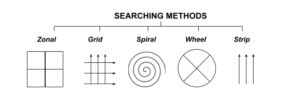
There are several common search methods, each method is chosen based on the size, type, and nature of the search area and the specific goals of the investigation or study.
- Grid Search: The search area is divided into a grid, and each section is thoroughly searched. Useful for small, confined areas.
- Zone or Sector Search: The area is divided into zones or sectors, and each one is searched individually. This is ideal for complex scenes with various rooms or barriers.
- Spiral Search: The searcher starts at a central point and moves outward in a circular or spiral pattern. This method is useful in large, open areas.
- Line or Strip Search: Searchers line up and move in a straight line across the area. Each person covers a specific width to ensure no gaps. This is effective for large, flat areas.
- Wheel Search: Similar to the zone search, but typically divides the area into sectors, each of which is searched thoroughly. Often used for large, specific search areas.
- Random Search: There is no systematic pattern; the search is conducted randomly, often in cases where time is limited, and precision is less critical.
Collection, Preservation, Packing & Forwarding of Physical & Trace evidence for forensic analyses
1. Collection of Physical & Trace Evidence
- Goal: Evidence is collected accurately, avoiding contamination or degradation.
- Types of Evidence:
- Physical Evidence: Larger, visible items like weapons, clothing, and bloodstains.
- Trace Evidence: Microscopic or smaller materials, such as hair, fibers, glass fragments, and soil.
- Steps:
- Document Scene: Photographs, videos, and detailed notes are taken before any items are moved or collected.
- Prioritize Evidence: Fragile or degradable evidence, such as biological samples, is collected first to prevent deterioration.
- Use Appropriate Tools: Tweezers, gloves, and masks are used to avoid contamination; bare hands do not touch evidence.
- Establish Chain of Custody: Every handler and transfer of evidence is recorded to maintain legal admissibility.
2. Preservation of Physical & Trace Evidence
- Goal: Evidence degradation or alteration is prevented until analysis.
- Methods:
- Temperature Control: Biological samples are refrigerated or frozen to prevent bacterial growth.
- Prevent Contamination: Different types of evidence are stored separately to avoid cross-contamination, such as keeping biological samples isolated.
- Protection from Environment: Evidence is shielded from sunlight, humidity, and extreme temperatures to prevent degradation.
- Minimize Handling: Direct handling is limited, and unnecessary movement or contact with evidence items is avoided.
- Documentation:
- Each item is labeled with a unique identifier, date, and collection details.
- Any preservation techniques or changes in the evidence’s condition after collection are documented.
3. Packing of Physical & Trace Evidence
- Goal: Evidence is packaged securely for lab transport, maintaining its integrity.
- Packing Techniques:
- Use Appropriate Packaging Materials:
- Biological evidence is placed in paper bags or envelopes (plastic is avoided to prevent DNA degradation).
- Trace evidence, like fibers and hair, is stored in small envelopes, glass vials, or druggist folds.
- Sharp objects are placed in rigid, puncture-resistant containers to prevent injury and contamination.
- Label Packaging: Each package is clearly labeled with evidence type, date, case number, and collector’s name.
- Seal Containers: Tamper-evident tape and seals are used to prevent unauthorized access.
- Use Appropriate Packaging Materials:
- Special Considerations:
- Evidence is packed separately to prevent cross-contamination, especially for biological samples.
- Hazardous materials are double-bagged to ensure secure containment.
4. Forwarding Evidence for Forensic Analysis
- Goal: Evidence is transported to the forensic lab, preserving the chain of custody and ensuring safe handling.
- Procedures:
- Chain of Custody Documentation: All necessary documentation, including transfer forms outlining the evidence’s history and handling, is completed.
- Forwarding Letter: A formal note accompanies the items sent to the lab, outlining the purpose, contents, and authorities’ signatures.
- Secure Transport: Lockable containers or tamper-evident bags are used, with handling limited to authorized personnel only.
- Special Handling Instructions: Specific handling requirements (e.g., refrigeration, fragile material) are clearly indicated on packaging and transfer forms.
Chain of Custody
Chain of custody is the process of maintaining and documenting the handling, transfer, and storage of evidence from the moment it is collected until it is presented in court or analysis is completed. It ensures that evidence is accounted for and remains uncontaminated and tamper-free, preserving its integrity for legal and investigative purposes.
Purpose:
- Legal Integrity: Establishes evidence as admissible in court by proving it has not been altered or tampered with.
- Accountability: Ensures that every individual who handles the evidence can be identified, supporting transparency in evidence handling.
- Authenticity: Confirms that evidence presented in court is the same as what was originally collected at the scene.
Key Components:
- Documentation:
- Each piece of evidence is accompanied by a chain of custody form that records the unique identifier, case details, date, time, and location of collection.
- Any transfer, examination, or alteration to the evidence must be documented in real-time, noting the name of each handler and any changes observed.
- Unique Identification:
- Evidence items are tagged or labeled with unique identifiers, like barcodes or alphanumeric codes, that correspond to chain of custody records.
- Tags include information such as the case number, collection date, location, and evidence type.
- Custody Transfers:
- Each transfer or handoff of evidence from one individual to another is logged, with signatures or initials from both parties to verify accountability.
- Only authorized personnel can access or handle evidence, reducing the risk of unauthorized interference.
- Security Measures:
- Evidence is stored in secure, controlled-access environments (e.g., locked evidence rooms or cabinets) when not being examined.
- Security protocols include limited access, tamper-evident seals, and alarm systems to prevent unauthorized access.
Process:
- Collection:
- Evidence is collected at the scene, documented thoroughly, and tagged with identifying information.
- The chain of custody form is initiated, noting collection details and the identity of the collector.
- Transfer and Handling:
- Evidence is transferred as needed for transport, analysis, or storage. Each transfer is logged, with both the sender and receiver recording the transaction.
- Handling is minimized to reduce contamination or damage; appropriate tools (gloves, forceps) are used.
- Storage:
- Evidence is stored securely, with conditions (e.g., temperature control) maintained according to evidence type.
- Log entries are made for any access or movement within storage facilities.
- Analysis:
- Evidence analyzed in labs is checked out and documented, noting the purpose and timeframe of the examination.
- Any alteration in the condition of evidence during analysis is documented, and chain of custody records are updated.
- Court Presentation:
- When evidence is presented in court, chain of custody documents are provided to establish its authenticity and reliability.
- After court proceedings, evidence is either stored, returned, or appropriately disposed of, with documentation maintained.
Importance:
- Ensures Reliability: A well-maintained chain of custody supports the credibility of evidence, increasing the reliability of forensic results.
- Protects Against Legal Challenges: Gaps or inconsistencies in chain of custody documentation can lead to evidence exclusion in court.
- Maintains Public Trust: Proper evidence handling builds public trust in investigative and legal institutions, showing transparency and accountability.
Challenges:
- Human Error: Mistakes in labeling, documentation, or handling can create gaps or inaccuracies.
- Storage Limitations: Inadequate facilities or security can compromise evidence integrity.
- Complexity in High-Volume Cases: Managing large amounts of evidence over long periods can strain record-keeping and storage systems.