

Organization of Forensic Science Laboratories of Centre and State, NCRB and NICFS.
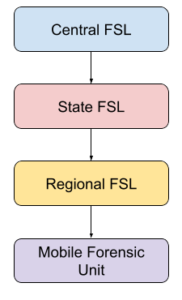
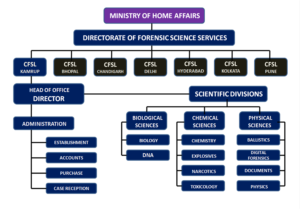
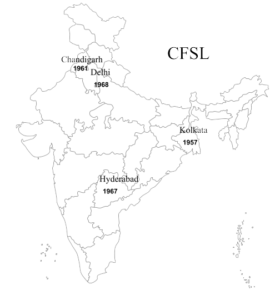
Central Forensic Science Laboratories (CFSLs)
- Operated by the Government of India under the Directorate of Forensic Science Services, providing expertise in various forensic disciplines to support national investigations.
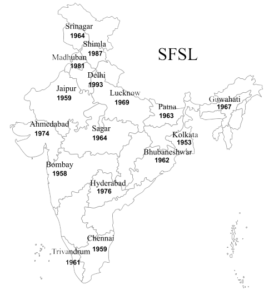
State Forensic Science Laboratories (FSLs)
- Managed by individual states, assisting local law enforcement agencies.
NCRB (National Crime Records Bureau)
- Collects, compiles, and maintains crime data, supporting data-driven policymaking.
- Works under the Ministry of Home Affairs
- Established in 1986
- NCRB plays a crucial role in modernizing police operations and supporting policymaking by offering reliable crime statistics and insights.
1. Objectives and Functions
- Data Collection and Analysis: Collects crime statistics from all states and union territories, producing annual reports like the Crime in India report.
- Crime and Criminal Tracking Network & Systems (CCTNS): Launched to digitize and connect police stations nationwide, CCTNS facilitates data sharing and efficient case management.
- Integrated Database Systems: NCRB manages databases such as the National Fingerprint Database (Automated Fingerprint Identification System – AFIS) and a central repository for cybercrime data.
2. Key Publications and Reports
- Crime in India: Comprehensive report providing data on crime trends, offenses, conviction rates, and demographics of criminals.
- Accidental Deaths & Suicides in India (ADSI): Annual report covering non-crime fatalities like suicides, road accidents, and natural disasters.
- Prison Statistics India: Offers insights into prison demographics, capacities, and the socio-economic backgrounds of inmates.
3. Technological Initiatives and Training
- National Automated Fingerprint Identification System (NAFIS): A digitized fingerprint database, aiding in identity verification and investigation.
- National Cybercrime Training Centre (NCTC): An online training platform for law enforcement to enhance cybercrime investigation skills.
- Coordination and Capacity-Building: NCRB conducts training sessions for police officers on data management, crime analytics, and cyber forensics.
4. Importance in Law Enforcement and Policy
- Policy Support: Provides data-driven insights for formulating and evaluating crime prevention policies.
- Enhanced Investigation: Facilitates sharing of critical information across states, improving inter-state crime investigation and tracking.
- Public Awareness: NCRB’s reports serve as a reference for researchers, policymakers, and the public, contributing to transparency and awareness about crime trends in India.
NICFS (Now NFSU)
- Trains forensic professionals and conducts research in criminology and forensic sciences.
- Established in 4 January 1972
- 1972-1976 was under BPRD, Later independent department under MHA
- Named as NICFS in 1991, Renamed as LNJN in 2003
- Started teaching courses in 2004
Fundamental Rights: Right of Equality (Articles 14 to 18)
- Art. 14: Equality before law and equal protection of laws
- State can’t deny to any person right to Equality
- Available to both citizens and foreigners
- Exceptions
- President, art.361
- Governor, art.361
- Foreign diplomats, ambassadors, sovereigns
- Members of parliament, art.105
- Members of state legislatures, art.194
- Implementation of certain DPSP, 31c
|
Equality before law |
Equal protection of laws |
|
|
- Art. 15: Prohibition of discrimination on grounds of Religion, race, caste, sex or place of birth
- Access to public shops, restaurants, hotels & places of public entertainment
- Use of wells, tanks, bathing ghats, roads & places wholly or partially maintained by gov.
- Exceptions
- Special provisions for women & children
- Provisions for advancement of socially & educationally backward classes { 1 C.A.A, 1951 }
- Provisions for admission of socially & educationally backward classes in educational institution including private { 93 C.A.A, 2004 }
- Art. 16: Equality of opportunity in matters of public employment
- State can prescribe necessary qualifications & recruitment tests
- Posts may reserved for residents of state
- Reservation of seats for backward classes
- Promotion on basis of consequential seniority { 85 C.A.A, 2001 & 77 C.A.A, 1995 }
- Separate vacancy for backlog for backward classes { 81 C.A.A, 2000 }
- Art. 17: Abolition of untouchability
- Prohibition of its practice in any form
- Untouchability (offences) act, 1955
- Civil rights (protection) act, 1976
|
Offences |
Punishments |
|
|
- Art. 18: Abolition of titles
- Military & academic titles permitted
- Citizens can’t accept foreign titles
- Foreigners can accept after president’s consent
Right of Freedom (Articles 19 to 22) as per the Constitution of India
- Art. 19: Guarantees 6 rights
- Speech & expression
- Assemble peacefully without arms
- Form association, unions & co-operatives{97th C.A.A, 2011}
- Move freely within territory of india
- Reside & settle in any part of india
- Practice any profession or to carry out any occupation, business or trade
- Art. 20: Protection in respect of conviction of offences
- No ex-post facto law
- No double jeopardy
- No self incrimination
- Art. 21: Protection of life and personal liberty
- Right to
- Live with human dignity
- Livelihood
- First aid
- Free legal aid
- Against handcuffing
- Privacy
- Travel abroad
- Art. 21 A: Right to education
- Free & compulsory edu.
- Earlier part of DPSP 45
- 6-14 yrs : elementary & primary edu.
- Embedded by 86th C.A.A, 2002
- RTE(Right to education) act, 2009
- 2005: Bill drafted
- 2009: Passed
- 1 April 2010: Enforced
- 25% quota in private schools for SC/ST/OBC/Disabled
- Art. 22: Protection against arrest & detention
|
Punitive |
Preventive |
|
|
- Preventive detention Act 1953, Repealed in 1969
- Maintenance of Integral Security Act (MISA) 1971, Repealed in 1978
- Conservation of Foreign Exchange and Prevention of Smuggling Activities Act (COFEPOSA) 1974
- National Security Act (NASA) 1980
- Prevention of Black Marketing And Maintenance of Supplies of Essential Commodities Act (PBMSECA) 1980
- Terrorist and Disruptive Activities (Prevention) Act (TADA) 1985, Repealed in 1995
- Prevention of Illicit Traffic in Narcotics Drugs and Psychotropic Substances Act (NDPSA) 1988
- Prevention of Terrorism Act(POTA) 2002, Repealed in 2004