

Criminal profiling
It is a method used to predict the characteristics, behavior, and psychological traits of offenders and victims in a crime investigation. It helps investigators narrow down suspects, understand motives, and anticipate possible future actions by analyzing behavior patterns and crime scene details.
Victim Profiling
- Objective: Identifies characteristics, habits, and background of the victim to determine why they were targeted.
- Role in Investigation: Offers insights into the offender’s motive, possible connection to the victim, and risk factors associated with the victim’s lifestyle.
- Information Analyzed: Age, gender, occupation, lifestyle, personal relationships, and any factors that might make the victim vulnerable.
Culprit Profiling
- Objective: Builds a psychological and behavioral profile of the suspect to aid in locating and apprehending them.
- Types of Information Used: Crime scene analysis, modus operandi (method of committing the crime), and potential psychological patterns.
- Behavioral Indicators: Analyzes repetitive behaviors, selection of victim type, and the nature of interaction with the victim to outline personality traits.
Role in Crime Investigation
- Narrowing Down Suspects: Profiles help focus on individuals matching the behavioral and psychological patterns identified.
- Understanding Motive and Intent: Assists investigators in determining the purpose of the crime (e.g., financial gain, revenge, thrill-seeking).
- Anticipating Next Moves: Profiling can predict future actions, especially in cases involving serial crimes, enabling proactive intervention.
- Interdisciplinary Use: Combines psychology, criminology, and forensic science to offer a comprehensive picture aiding law enforcement agencies.
Lie Detection Techniques
- Lie Detection techniques are controversial, unproven, and of questionable accuracy
- On May 5, 2010 the Supreme Court of India in the case of Smt. Selvi vs. State of Karnataka declared
- Lie Detection, Narco Analysis & Brain Mapping Unconstitutional
- It Violates Article 20(3) of Fundamental Rights
- These techniques requires consent & cannot be conducted forcefully
- When conducted with consent
- Consent should be recorded before a Judicial Magistrate
- Is regarded as evidence according to Section 27 of IEA
- Suspects right are mentioned in National Human Rights Commision (NHRC)
- Section 161(2) of the Code of Criminal Procedure : Such person shall be bound to answer truly all questions relating to such case put to him by such officer, other than questions the answers to which would have a tendency to expose him to a criminal charge or to a penalty or forfeiture.
Lie Detection (Polygraphy)
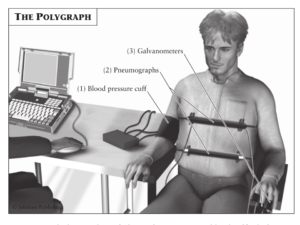
- Polygraph is a Greek word meaning “many writings”
- AKA –
- Psycho- Physiological detection of Deception (PDD)
- Truth verification
- Detection of truth
- A polygraph is a machine in which the multiple (“poly”) signals from the sensors are recorded on a single strip of moving paper (“graph”).
- Purpose of polygraph
- event-specific investigation
- Crime investigation
History
-
- 1885 : Cesare Lombroso -recorded suspects’ blood pressure as police questioned them.
- William Moulton Marston invented a device that measured blood pressure automatically during questioning
- Vittorio Benussi – focused on breathing, or respiration as Breathing speeds up during stress
- 1921 : John Larson – invented a machine that measured blood pressure, pulse (heartbeat), and respiration
- Leonarde Keeler
-
-
- improved the polygraph
- added a third measurement i.e. galvanic skin response (GSR), shows the degree to which a person’s skin conducts electricity.
- Conductivity depends on the amount of sweat produced by skin
-
- 1925 : Keeler patents his version of the polygraph
- 1981 : David Lykken develops “guilty knowledge” form of questioning for polygraph tests
Principle
- The interaction of emotions and body when a person tell lies causes certain changes in the body which are both visible and invisible.These changes are measured by lie detection technique.
- Perception or consciously held feelings of guilt produce a defence mechanism toward off the impending punishment of crime.
Working
- Polygraph testing combines interrogation with physiological measurements obtained using the polygraph
- The polygraph relies on measurements of autonomic and somatic activity.
- Steps in polygraph analysis:
- Setting up the polygraph and preparing the subject being tested
- Asking questions
- Profiling the test subject
- Analyzing and evaluating test data
- Records physiological phenomena—typically
- respiration
- heart rate
- blood pressure
- electrodermal response (electrical conductance at the skin surface)
- Pneumograph :
- It’s a corrugated rubber tube
-
-
- Tied around the subject’s chest
- It measures respiratory changes
- When the chest or abdominal muscles expand, the air inside the tubes is displaced.
- In an analog polygraph, the displaced air acts on a bellows, an accordion-like device that contracts when the tubes expand.
- This bellows is attached to a mechanical arm, which is connected to an ink-filled pen that makes marks on the scrolling paper when the subject takes a breath.
- A digital polygraph also uses the pneumographs, but employs transducers to convert the energy of the displaced air into electronic signals.
- Sphygmograph :
- It is an inflated cuff.
- It’s wrapped around the upper arm.
- It measures cardiovascular changes.
- As blood pumps through the arm it makes sound; the changes in pressure caused by the sound displace the air in the tubes, which are connected to a bellows, which moves the pen.
-
- Electrode :
-
- it is attached to the palm of finger it measures the galvanic skin response
- Principle : When the device is placed in contact with a person’s fingertips, a speaker, by a drop in its pitch, signals an increase in the skin’s conductivity that can result from the perspiration produced when a lie is told.
- Plethysmograph :
- It is a transducer.
- It is attached to the thumb.
- It measures the blood volume reflecting the pulse rate.
- A polygraph examination includes a series of yes/no questions to which the examinee responds while connected to sensors that transmit data on these physiological phenomena by wire to the instrument, which uses analog or digital technology to record the data
- All the readings are recorded on the polygraph paper collectively known as polygram.
Techniques
During questioning the subject following approach is applied
- Relevant/ irrelevant questions (RIQ)
- Peak of tension technique (POT)
- Only one pertinent but emotionally charged question is asked
- Control question technique (CQT)
- Miscellaneous technique
- Multiple general question technique
- Guilty knowledge test
- Silent answer technique
- Asking questions to which subject must lie
Limitations
- Measures changes in blood pressure, breath rate and perspiration rate, but these physiological changes can be triggered by a wide range of emotions.
Narco Analysis
- Term was coined by Horseley & Means “Anaesthesia” or “Torpor”
- Also known as Truth Serum or Drug Hypnosis or Narco Interview technique
- Hypnosis is induced by using Barbiturates or other psychotropic drugs
- 1st used in 1922, when Robert House, a Texas obstetrician used the drug Scopolamine on two prisoners in America
- Application was first documented by Dr. William Bleckwenn
- Principle : By using imagination a person is able to lie In this test, subject’s imagination is neutralised by making him/her semi-conscious in this state, it becomes difficult to lie and answers would be restricted to facts s/he is already aware of
- Team of Experts :
- Clinical Forensic Psychologist
- Psychiatrist
- Physician
- Anesthetist
- Audio-Videographer
- Writer
- Procedure: It includes
- Pre Test Interview
- Pre-Narcotic State Interview
- Semi-Narcotic State Interview
- Post Test Interview
- Drug :
- known as ‘truth drug’ or ‘truth serum’ : ethanol, scopolamine, 3-quinuclidinyl benzilate, midazolam, flunitrazepam, sodium thiopental, and amobarbital
- Sodium Pentothal or Sodium Amytal is given intravenously to induce hypnosis
- A 5% or 10% solution of drug injected slowly in antecubital vein
- As individual’s speech starts slurring interview begins
- Other Methods
- 0.5 mg scopolamine hydrobromide, subcutaneously, followed by 0.25 mg every 20 min (average 3-6 injections), till proper stage of questioning is reached
- 100 mg sodium seconal, 15 mg morphine and 0.5 mg of scopolamine hydrobromide may be given
- Wrong dose can result in a person going into a coma, or even death.
- MOA:
- Sodium Pentothal(thiopental,Thiopentone)is a rapid onset, Short acting barbiturate
- Acts on GABA-A Receptor
- GABA Receptor are Inhibitory channel & barbiturate enhance inhibitory activity
Brain Mapping
-
- Invented by Lawrence Farewell in 1995
- It is a Lie Detection Technique which uses Electroencephalography(EEG)
- Detects concealed information stored in the brain by measuring brainwave responses
- Measures the response to Visual & Auditory Stimulus
- Stimulus: Thing or Event that evokes specific functional reaction in an Organ or Tissue
- It measures electrical brainwave responses to words, phrases or pictures presented on a computer screen
- Uses cognitive brain responses & does not depends on emotions
- Electroencephalography (EEG) :
- Measurement of electrical activity produced by brain as recorded from electrodes placed on the scalp
- 10 -100s of electrodes positioned on different locations of the head
- EEG signals(in range of mini-volts) are amplified & digitalized after processing
- P300 :
-
- Uses brain response to detect brain’s recognition of known information
- P300 is an event related potentials (ERP) which can be recorded via Electroencephalography (EEG)
- Electrical signals known as P300 is emitted approximately 300 milliseconds after it is confronted with the stimulus
- Based on electrical signal known as MERMER (Memory & Encoding Related Multifaceted Electrophalohgraphic Response)
- Utilizes late Negative Potentials (LNP)
- Brain Signature Profiling (BSP) or Brain Electrical Oscillation Signature (BEOS) is another EEG procedure
- Developed in 2003 by CR Mukundan
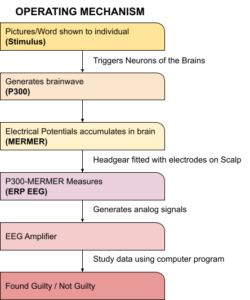
- Suspect is tested looking at 3 types of information
- ― RED : Target
- Information the suspect is expected to know
- ― GREEN : Irrelevant
- Information not known to suspect
- ― BLUE : Probes
- Information of Crime that only suspect would know
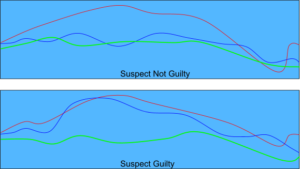
- It has a record of 100% accuracy